 |
Open CASCADE Technology Reference Manual 8.0.0
|
Loading...
Searching...
No Matches
|
Open CASCADE Technology Reference Manual 8.0.0
|
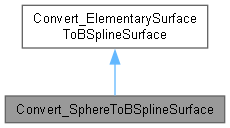
This algorithm converts a bounded Sphere into a rational B-spline surface. The sphere is a Sphere from package gp. The parametrization of the sphere is: P (U, V) = Loc + Radius * std::sin(V) * Zdir + Radius * std::cos(V) * (std::cos(U)*Xdir + std::sin(U)*Ydir) where Loc is the center of the sphere Xdir, Ydir and Zdir are the normalized directions of the local cartesian coordinate system of the sphere. The parametrization range is U [0, 2PI] and V [-PI/2, PI/2]. KeyWords : Convert, Sphere, BSplineSurface. More...
#include <Convert_SphereToBSplineSurface.hxx>
Public Member Functions | |
| Convert_SphereToBSplineSurface (const gp_Sphere &Sph, const double U1, const double U2, const double V1, const double V2) | |
| The equivalent B-spline surface as the same orientation as the sphere in the U and V parametric directions. | |
| Convert_SphereToBSplineSurface (const gp_Sphere &Sph, const double Param1, const double Param2, const bool UTrim=true) | |
| The equivalent B-spline surface as the same orientation as the sphere in the U and V parametric directions. | |
| Convert_SphereToBSplineSurface (const gp_Sphere &Sph) | |
| The equivalent B-spline surface as the same orientation as the sphere in the U and V parametric directions. | |
 Public Member Functions inherited from Convert_ElementarySurfaceToBSplineSurface Public Member Functions inherited from Convert_ElementarySurfaceToBSplineSurface | |
| int | UDegree () const |
| Returns the degree in the U parametric direction. | |
| int | VDegree () const |
| Returns the degree in the V parametric direction. | |
| int | NbUPoles () const |
| Returns the number of poles in the U parametric direction. | |
| int | NbVPoles () const |
| Returns the number of poles in the V parametric direction. | |
| int | NbUKnots () const |
| Returns the number of knots in the U parametric direction. | |
| int | NbVKnots () const |
| Returns the number of knots in the V parametric direction. | |
| bool | IsUPeriodic () const |
| Returns true if the surface is periodic in the U parametric direction. | |
| bool | IsVPeriodic () const |
| Returns true if the surface is periodic in the V parametric direction. | |
| gp_Pnt | Pole (const int UIndex, const int VIndex) const |
| Returns the pole of index (UIndex, VIndex). | |
| double | Weight (const int UIndex, const int VIndex) const |
| Returns the weight of the pole of index (UIndex, VIndex). | |
| double | UKnot (const int UIndex) const |
| Returns the U-knot of range UIndex. | |
| double | VKnot (const int VIndex) const |
| Returns the V-knot of range VIndex. | |
| int | UMultiplicity (const int UIndex) const |
| Returns the multiplicity of the U-knot of range UIndex. | |
| int | VMultiplicity (const int VIndex) const |
| Returns the multiplicity of the V-knot of range VIndex. | |
| const NCollection_Array2< gp_Pnt > & | Poles () const |
| Returns the poles of the BSpline surface. | |
| const NCollection_Array2< double > & | Weights () const |
| Returns the weights of the BSpline surface. | |
| const NCollection_Array1< double > & | UKnots () const |
| Returns the U-knots of the BSpline surface. | |
| const NCollection_Array1< double > & | VKnots () const |
| Returns the V-knots of the BSpline surface. | |
| const NCollection_Array1< int > & | UMultiplicities () const |
| Returns the U-multiplicities of the BSpline surface. | |
| const NCollection_Array1< int > & | VMultiplicities () const |
| Returns the V-multiplicities of the BSpline surface. | |
Additional Inherited Members | |
| Protected Member Functions inherited from Convert_ElementarySurfaceToBSplineSurface | |
| Convert_ElementarySurfaceToBSplineSurface (const int theNbUPoles, const int theNbVPoles, const int theNbUKnots, const int theNbVKnots, const int theUDegree, const int theVDegree) | |
| void | Finalize () |
| Resizes internal arrays (poles, weights, knots, multiplicities) to match the actual sizes stored in myNbUPoles, myNbVPoles, myNbUKnots, and myNbVKnots. This is intended to be called at the end of derived class constructors when the base class constructor allocates arrays with maximum possible sizes but the derived constructor uses fewer elements. | |
| Protected Attributes inherited from Convert_ElementarySurfaceToBSplineSurface | |
| NCollection_Array2< gp_Pnt > | myPoles |
| NCollection_Array2< double > | myWeights |
| NCollection_Array1< double > | myUKnots |
| NCollection_Array1< double > | myVKnots |
| NCollection_Array1< int > | myUMults |
| NCollection_Array1< int > | myVMults |
| int | myUDegree = 0 |
| int | myVDegree = 0 |
| bool | myIsUPeriodic = false |
| bool | myIsVPeriodic = false |
| int | myNbUPoles |
| int | myNbVPoles |
| int | myNbUKnots |
| int | myNbVKnots |
This algorithm converts a bounded Sphere into a rational B-spline surface. The sphere is a Sphere from package gp. The parametrization of the sphere is: P (U, V) = Loc + Radius * std::sin(V) * Zdir + Radius * std::cos(V) * (std::cos(U)*Xdir + std::sin(U)*Ydir) where Loc is the center of the sphere Xdir, Ydir and Zdir are the normalized directions of the local cartesian coordinate system of the sphere. The parametrization range is U [0, 2PI] and V [-PI/2, PI/2]. KeyWords : Convert, Sphere, BSplineSurface.
| Convert_SphereToBSplineSurface::Convert_SphereToBSplineSurface | ( | const gp_Sphere & | Sph, |
| const double | U1, | ||
| const double | U2, | ||
| const double | V1, | ||
| const double | V2 ) |
The equivalent B-spline surface as the same orientation as the sphere in the U and V parametric directions.
Raised if U1 = U2 or U1 = U2 + 2.0 * Pi Raised if V1 = V2.
| Convert_SphereToBSplineSurface::Convert_SphereToBSplineSurface | ( | const gp_Sphere & | Sph, |
| const double | Param1, | ||
| const double | Param2, | ||
| const bool | UTrim = true ) |
The equivalent B-spline surface as the same orientation as the sphere in the U and V parametric directions.
Raised if UTrim = True and Param1 = Param2 or Param1 = Param2 + 2.0 * Pi Raised if UTrim = False and Param1 = Param2
| Convert_SphereToBSplineSurface::Convert_SphereToBSplineSurface | ( | const gp_Sphere & | Sph | ) |
The equivalent B-spline surface as the same orientation as the sphere in the U and V parametric directions.
 1.10.0