 |
Open CASCADE Technology Reference Manual 8.0.0
|
Loading...
Searching...
No Matches
|
Open CASCADE Technology Reference Manual 8.0.0
|
Defines services which are required to load an InterfaceModel from a File. Typically, it may firstly transform a system file into a FileReaderData object, then work on it, not longer considering file contents, to load an Interface Model. It may also work on a FileReaderData already loaded. More...
#include <Interface_FileReaderTool.hxx>
Public Member Functions | |
| void | SetData (const occ::handle< Interface_FileReaderData > &reader, const occ::handle< Interface_Protocol > &protocol) |
| Sets Data to a FileReaderData. Works with a Protocol. | |
| occ::handle< Interface_Protocol > | Protocol () const |
| Returns the Protocol given at creation time. | |
| occ::handle< Interface_FileReaderData > | Data () const |
| Returns the FileReaderData which is used to work. | |
| void | SetModel (const occ::handle< Interface_InterfaceModel > &amodel) |
| Stores a Model. Used when the Model has been loaded. | |
| occ::handle< Interface_InterfaceModel > | Model () const |
| Returns the stored Model. | |
| void | SetMessenger (const occ::handle< Message_Messenger > &messenger) |
| Sets Messenger used for outputting messages. | |
| occ::handle< Message_Messenger > | Messenger () const |
| Returns Messenger used for outputting messages. The returned object is guaranteed to be non-null; default is Message::Messenger(). | |
| void | SetTraceLevel (const int tracelev) |
| Sets trace level used for outputting messages. | |
| int | TraceLevel () const |
| Returns trace level used for outputting messages. | |
| void | SetErrorHandle (const bool err) |
| Allows controlling whether exception raisings are handled If err is False, they are not (hence, dbx can take control) If err is True, they are, and they are traced (by putting on messenger Entity's Number and file record num) Default given at Model's creation time is True. | |
| bool | ErrorHandle () const |
| Returns ErrorHandle flag. | |
| void | SetEntities () |
| Fills records with empty entities; once done, each entity can ask the FileReaderTool for any entity referenced through an identifier. Calls Recognize which is specific to each specific type of FileReaderTool. | |
| virtual bool | Recognize (const int num, occ::handle< Interface_Check > &ach, occ::handle< Standard_Transient > &ent)=0 |
| Recognizes a record, given its number. Specific to each Interface; called by SetEntities. It can call the basic method RecognizeByLib. Returns False if recognition has failed, True else. <ach> has not to be filled if simply Recognition has failed : it must record true error messages : RecognizeByLib can generate error messages if NewRead is called. | |
| bool | RecognizeByLib (const int num, Interface_GeneralLib &glib, Interface_ReaderLib &rlib, occ::handle< Interface_Check > &ach, occ::handle< Standard_Transient > &ent) const |
| Recognizes a record with the help of Libraries. Can be used to implement the method Recognize. <rlib> is used to find Protocol and CaseNumber to apply <glib> performs the creation (by service NewVoid, or NewRead if NewVoid gave no result) <ach> is a check, which is transmitted to NewRead if it is called, gives a result but which is false <ent> is the result Returns False if recognition has failed, True else. | |
| occ::handle< Standard_Transient > | UnknownEntity () const |
| Provides an unknown entity, specific to the Interface called by SetEntities when Recognize has failed (Unknown alone) or by LoadModel when an Entity has caused a Fail on reading (to keep at least its literal description) Uses Protocol to do it. | |
| occ::handle< Interface_InterfaceModel > | NewModel () const |
| Creates an empty Model of the norm. Uses Protocol to do it. | |
| void | LoadModel (const occ::handle< Interface_InterfaceModel > &amodel) |
| Reads and fills Entities from the FileReaderData set by SetData to an InterfaceModel. It enchains required operations, the specific ones correspond to deferred methods (below) to be defined for each Norm. It manages also error recovery and trace. Remark : it calls SetModel. It Can raise any error which can occur during a load operation, unless Error Handling is set. This method can also be redefined if judged necessary. | |
| occ::handle< Standard_Transient > | LoadedEntity (const int num) |
| Reads, Fills and Returns one Entity read from a Record of the FileReaderData. This Method manages also case of Fail or Warning, by producing a ReportEntyty plus , for a Fail, a literal Content (as an UnknownEntity). Performs also Trace. | |
| virtual void | BeginRead (const occ::handle< Interface_InterfaceModel > &amodel)=0 |
| Fills model's header; each Interface defines for its Model its own file header; this method fills it from FileReaderTool.+ It is called by AnalyseFile from InterfaceModel. | |
| virtual bool | AnalyseRecord (const int num, const occ::handle< Standard_Transient > &anent, occ::handle< Interface_Check > &acheck)=0 |
| Fills an Entity, given record no; specific to each Interface, called by AnalyseFile from InterfaceModel (which manages its calling arguments) To work, each Interface can define a method in its proper Transient class, like this (given as an example) : AnalyseRecord (me : mutable; FR : in out FileReaderTool; num : Integer; acheck : in out Check) returns Boolean; and call it from AnalyseRecord. | |
| virtual | ~Interface_FileReaderTool () |
| virtual void | EndRead (const occ::handle< Interface_InterfaceModel > &amodel) |
| Ends file reading after reading all the entities default is doing nothing; redefinable as necessary. | |
| void | Clear () |
| Clear fields. | |
Protected Member Functions | |
| Interface_FileReaderTool () | |
| Constructor; sets default fields. | |
Defines services which are required to load an InterfaceModel from a File. Typically, it may firstly transform a system file into a FileReaderData object, then work on it, not longer considering file contents, to load an Interface Model. It may also work on a FileReaderData already loaded.
FileReaderTool provides, on one hand, some general services which are common to all read operations but can be redefined, plus general actions to be performed specifically for each Norm, as deferred methods to define.
In particular, FileReaderTool defines the Interface's Unknown and Error entities
|
virtual |
|
protected |
Constructor; sets default fields.
|
pure virtual |
Fills an Entity, given record no; specific to each Interface, called by AnalyseFile from InterfaceModel (which manages its calling arguments) To work, each Interface can define a method in its proper Transient class, like this (given as an example) : AnalyseRecord (me : mutable; FR : in out FileReaderTool; num : Integer; acheck : in out Check) returns Boolean; and call it from AnalyseRecord.
Returned Value : True if the entity could be loaded, False else (in case of syntactic fail)
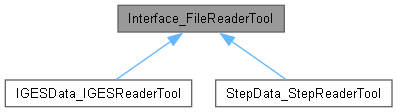
Implemented in IGESData_IGESReaderTool, and StepData_StepReaderTool.
|
pure virtual |
Fills model's header; each Interface defines for its Model its own file header; this method fills it from FileReaderTool.+ It is called by AnalyseFile from InterfaceModel.
Implemented in IGESData_IGESReaderTool, and StepData_StepReaderTool.
| void Interface_FileReaderTool::Clear | ( | ) |
Clear fields.
| occ::handle< Interface_FileReaderData > Interface_FileReaderTool::Data | ( | ) | const |
Returns the FileReaderData which is used to work.
|
virtual |
Ends file reading after reading all the entities default is doing nothing; redefinable as necessary.
Reimplemented in IGESData_IGESReaderTool, and StepData_StepReaderTool.
| bool Interface_FileReaderTool::ErrorHandle | ( | ) | const |
Returns ErrorHandle flag.
| occ::handle< Standard_Transient > Interface_FileReaderTool::LoadedEntity | ( | const int | num | ) |
Reads, Fills and Returns one Entity read from a Record of the FileReaderData. This Method manages also case of Fail or Warning, by producing a ReportEntyty plus , for a Fail, a literal Content (as an UnknownEntity). Performs also Trace.
| void Interface_FileReaderTool::LoadModel | ( | const occ::handle< Interface_InterfaceModel > & | amodel | ) |
Reads and fills Entities from the FileReaderData set by SetData to an InterfaceModel. It enchains required operations, the specific ones correspond to deferred methods (below) to be defined for each Norm. It manages also error recovery and trace. Remark : it calls SetModel. It Can raise any error which can occur during a load operation, unless Error Handling is set. This method can also be redefined if judged necessary.
| occ::handle< Message_Messenger > Interface_FileReaderTool::Messenger | ( | ) | const |
Returns Messenger used for outputting messages. The returned object is guaranteed to be non-null; default is Message::Messenger().
| occ::handle< Interface_InterfaceModel > Interface_FileReaderTool::Model | ( | ) | const |
Returns the stored Model.
| occ::handle< Interface_InterfaceModel > Interface_FileReaderTool::NewModel | ( | ) | const |
Creates an empty Model of the norm. Uses Protocol to do it.
| occ::handle< Interface_Protocol > Interface_FileReaderTool::Protocol | ( | ) | const |
Returns the Protocol given at creation time.
|
pure virtual |
Recognizes a record, given its number. Specific to each Interface; called by SetEntities. It can call the basic method RecognizeByLib. Returns False if recognition has failed, True else. <ach> has not to be filled if simply Recognition has failed : it must record true error messages : RecognizeByLib can generate error messages if NewRead is called.
Note that it works thru a Recognizer (method Evaluate) which has to be memorized before starting
Implemented in IGESData_IGESReaderTool, and StepData_StepReaderTool.
| bool Interface_FileReaderTool::RecognizeByLib | ( | const int | num, |
| Interface_GeneralLib & | glib, | ||
| Interface_ReaderLib & | rlib, | ||
| occ::handle< Interface_Check > & | ach, | ||
| occ::handle< Standard_Transient > & | ent ) const |
Recognizes a record with the help of Libraries. Can be used to implement the method Recognize. <rlib> is used to find Protocol and CaseNumber to apply <glib> performs the creation (by service NewVoid, or NewRead if NewVoid gave no result) <ach> is a check, which is transmitted to NewRead if it is called, gives a result but which is false <ent> is the result Returns False if recognition has failed, True else.
| void Interface_FileReaderTool::SetData | ( | const occ::handle< Interface_FileReaderData > & | reader, |
| const occ::handle< Interface_Protocol > & | protocol ) |
Sets Data to a FileReaderData. Works with a Protocol.
| void Interface_FileReaderTool::SetEntities | ( | ) |
Fills records with empty entities; once done, each entity can ask the FileReaderTool for any entity referenced through an identifier. Calls Recognize which is specific to each specific type of FileReaderTool.
Allows controlling whether exception raisings are handled If err is False, they are not (hence, dbx can take control) If err is True, they are, and they are traced (by putting on messenger Entity's Number and file record num) Default given at Model's creation time is True.
| void Interface_FileReaderTool::SetMessenger | ( | const occ::handle< Message_Messenger > & | messenger | ) |
Sets Messenger used for outputting messages.
| void Interface_FileReaderTool::SetModel | ( | const occ::handle< Interface_InterfaceModel > & | amodel | ) |
Stores a Model. Used when the Model has been loaded.
Sets trace level used for outputting messages.
| int Interface_FileReaderTool::TraceLevel | ( | ) | const |
Returns trace level used for outputting messages.
| occ::handle< Standard_Transient > Interface_FileReaderTool::UnknownEntity | ( | ) | const |
Provides an unknown entity, specific to the Interface called by SetEntities when Recognize has failed (Unknown alone) or by LoadModel when an Entity has caused a Fail on reading (to keep at least its literal description) Uses Protocol to do it.
 1.10.0