 |
Open CASCADE Technology Reference Manual 8.0.0
|
Loading...
Searching...
No Matches
|
Open CASCADE Technology Reference Manual 8.0.0
|
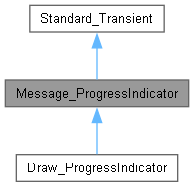
Defines abstract interface from program to the user. This includes progress indication and user break mechanisms. More...
#include <Message_ProgressIndicator.hxx>
Protected Member Functions | |
Virtual methods to be defined by descendant. | |
| virtual bool | UserBreak () |
| Should return True if user has sent a break signal. | |
| virtual void | Show (const Message_ProgressScope &theScope, const bool isForce)=0 |
| Virtual method to be defined by descendant. Should update presentation of the progress indicator. | |
| virtual void | Reset () |
| Call-back method called by Start(), can be redefined by descendants if some actions are needed when the indicator is restarted. | |
Auxiliary methods | |
| double | GetPosition () const |
| Returns total progress position ranged from 0 to 1. Should not be called concurrently while the progress is advancing, except from implementation of method Show(). | |
| ~Message_ProgressIndicator () override | |
| Destructor. | |
| Message_ProgressIndicator () | |
| Constructor. | |
Initialization of progress indication | |
| Message_ProgressRange | Start () |
| Resets the indicator to zero, calls Reset(), and returns the range. This range refers to the scope that has no name and is initialized with max value 1 and step 1. Use this method to get the top level range for progress indication. | |
| static Message_ProgressRange | Start (const occ::handle< Message_ProgressIndicator > &theProgress) |
| If argument is non-null handle, returns theProgress->Start(). Otherwise, returns dummy range that can be safely used in the algorithms but not bound to progress indicator. | |
Additional Inherited Members | |
 Public Types inherited from Standard_Transient Public Types inherited from Standard_Transient | |
| typedef void | base_type |
| Returns a type descriptor about this object. | |
| Public Member Functions inherited from Standard_Transient | |
| Standard_Transient () | |
| Empty constructor. | |
| Standard_Transient (const Standard_Transient &) | |
| Copy constructor – does nothing. | |
| Standard_Transient & | operator= (const Standard_Transient &) |
| Assignment operator, needed to avoid copying reference counter. | |
| virtual | ~Standard_Transient ()=default |
| Destructor must be virtual. | |
| virtual const opencascade::handle< Standard_Type > & | DynamicType () const |
| Returns a type descriptor about this object. | |
| bool | IsInstance (const opencascade::handle< Standard_Type > &theType) const |
| Returns a true value if this is an instance of Type. | |
| bool | IsInstance (const char *const theTypeName) const |
| Returns a true value if this is an instance of TypeName. | |
| bool | IsKind (const opencascade::handle< Standard_Type > &theType) const |
| Returns true if this is an instance of Type or an instance of any class that inherits from Type. Note that multiple inheritance is not supported by OCCT RTTI mechanism. | |
| bool | IsKind (const char *const theTypeName) const |
| Returns true if this is an instance of TypeName or an instance of any class that inherits from TypeName. Note that multiple inheritance is not supported by OCCT RTTI mechanism. | |
| Standard_Transient * | This () const |
| Returns non-const pointer to this object (like const_cast). For protection against creating handle to objects allocated in stack or call from constructor, it will raise exception Standard_ProgramError if reference counter is zero. | |
| int | GetRefCount () const noexcept |
| Get the reference counter of this object. | |
| void | IncrementRefCounter () noexcept |
| Increments the reference counter of this object. Uses relaxed memory ordering since incrementing only requires atomicity, not synchronization with other memory operations. | |
| int | DecrementRefCounter () noexcept |
| Decrements the reference counter of this object; returns the decremented value. Uses release ordering for the decrement to ensure all writes to the object are visible before the count reaches zero. An acquire fence is added only when the count reaches zero, ensuring proper synchronization before deletion. This is more efficient than using acq_rel for every decrement. | |
| virtual void | Delete () const |
| Memory deallocator for transient classes. | |
| Static Public Member Functions inherited from Standard_Transient | |
| static constexpr const char * | get_type_name () |
| Returns a type descriptor about this object. | |
| static const opencascade::handle< Standard_Type > & | get_type_descriptor () |
| Returns type descriptor of Standard_Transient class. | |
Defines abstract interface from program to the user. This includes progress indication and user break mechanisms.
The progress indicator controls the progress scale with range from 0 to 1.
Method Start() should be called once, at the top level of the call stack, to reset progress indicator and get access to the root range:
To advance the progress indicator in the algorithm, use the class Message_ProgressScope that provides iterator-like interface for incrementing progress; see documentation of that class for details. The object of class Message_ProgressRange will automatically advance the indicator if it is not passed to any Message_ProgressScope.
The progress indicator supports concurrent processing and can be used in multithreaded applications.
The derived class should be created to connect this interface to actual implementation of progress indicator, to take care of visualization of the progress (e.g. show total position at the graphical bar, print scopes in text mode, or else), and for implementation of user break mechanism (if necessary).
See details in documentation of methods Show() and UserBreak().
|
override |
Destructor.
|
protected |
Constructor.
|
inline |
Returns total progress position ranged from 0 to 1. Should not be called concurrently while the progress is advancing, except from implementation of method Show().
Call-back method called by Start(), can be redefined by descendants if some actions are needed when the indicator is restarted.
Reimplemented in Draw_ProgressIndicator.
|
protectedpure virtual |
Virtual method to be defined by descendant. Should update presentation of the progress indicator.
It is called whenever progress position is changed. Calls to this method from progress indicator are protected by mutex so that it is never called concurrently for the same progress indicator instance. Show() should return as soon as possible to reduce thread contention in multithreaded algorithms.
It is recommended to update (redraw, output etc.) only if progress is advanced by at least 1% from previous update.
Flag isForce is intended for forcing update in case if it is required at particular step of the algorithm; all calls to it from inside the core mechanism (Message_Progress... classes) are done with this flag equal to False.
The parameter theScope is the current scope being advanced; it can be used to show the names and ranges of the on-going scope and its parents, providing more visibility of the current stage of the process.
Implemented in Draw_ProgressIndicator.
| Message_ProgressRange Message_ProgressIndicator::Start | ( | ) |
Resets the indicator to zero, calls Reset(), and returns the range. This range refers to the scope that has no name and is initialized with max value 1 and step 1. Use this method to get the top level range for progress indication.
|
static |
If argument is non-null handle, returns theProgress->Start(). Otherwise, returns dummy range that can be safely used in the algorithms but not bound to progress indicator.
Should return True if user has sent a break signal.
This method can be called concurrently, thus implementation should be thread-safe. It should not call Show() or Position() to avoid possible data races. The method should return as soon as possible to avoid delaying the calling algorithm.
Default implementation returns False.
Reimplemented in Draw_ProgressIndicator.
 1.10.0