 |
Open CASCADE Technology Reference Manual 8.0.0
|
Loading...
Searching...
No Matches
|
Open CASCADE Technology Reference Manual 8.0.0
|
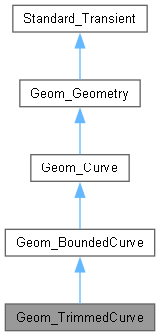
Describes a portion of a curve (termed the "basis curve") limited by two parameter values inside the parametric domain of the basis curve. The trimmed curve is defined by: More...
#include <Geom_TrimmedCurve.hxx>
Public Member Functions | |
| Geom_TrimmedCurve (const occ::handle< Geom_Curve > &C, const double U1, const double U2, const bool Sense=true, const bool theAdjustPeriodic=true) | |
| Constructs a trimmed curve from the basis curve C which is limited between parameter values U1 and U2. Note: - U1 can be greater or less than U2; in both cases, the returned curve is oriented from U1 to U2. | |
| void | Reverse () final |
| Changes the orientation of this trimmed curve. As a result: | |
| double | ReversedParameter (const double U) const final |
| Computes the parameter on the reversed curve for the point of parameter U on this trimmed curve. | |
| void | SetTrim (const double U1, const double U2, const bool Sense=true, const bool theAdjustPeriodic=true) |
| Changes this trimmed curve, by redefining the parameter values U1 and U2 which limit its basis curve. Note: If the basis curve is periodic, the trimmed curve has the same orientation as the basis curve if Sense is true (default value) or the opposite orientation if Sense is false. Warning If the basis curve is periodic and theAdjustPeriodic is True, the bounds of the trimmed curve may be different from U1 and U2 if the parametric origin of the basis curve is within the arc of the trimmed curve. In this case, the modified parameter will be equal to U1 or U2 plus or minus the period. When theAdjustPeriodic is False, parameters U1 and U2 will be the same, without adjustment into the first period. Exceptions Standard_ConstructionError if: | |
| occ::handle< Geom_Curve > | BasisCurve () const |
| Returns the basis curve. Warning This function does not return a constant reference. Consequently, any modification of the returned value directly modifies the trimmed curve. | |
| GeomAbs_Shape | Continuity () const final |
| Returns the continuity of the curve : C0 : only geometric continuity, C1 : continuity of the first derivative all along the Curve, C2 : continuity of the second derivative all along the Curve, C3 : continuity of the third derivative all along the Curve, CN : the order of continuity is infinite. | |
| bool | IsCN (const int N) const final |
| Returns true if the degree of continuity of the basis curve of this trimmed curve is at least N. A trimmed curve is at least "C0" continuous. Warnings : The continuity of the trimmed curve can be greater than the continuity of the basis curve because you consider only a part of the basis curve. Raised if N < 0. | |
| gp_Pnt | EndPoint () const final |
| Returns the end point of <me>. This point is the evaluation of the curve for the "LastParameter". | |
| double | FirstParameter () const final |
| Returns the value of the first parameter of <me>. The first parameter is the parameter of the "StartPoint" of the trimmed curve. | |
| bool | IsClosed () const final |
| Returns TRUE if the basis curve is periodic and the trim spans exactly one full period, or if the distance between the StartPoint and the EndPoint is within computational precision. | |
| bool | IsPeriodic () const final |
| Returns TRUE if the basis curve is periodic and the trim spans exactly one full period. Returns FALSE otherwise. | |
| double | Period () const final |
| Returns the period of the basis curve of this trimmed curve. Exceptions Standard_NoSuchObject if the basis curve is not periodic. | |
| double | LastParameter () const final |
| Returns the value of the last parameter of <me>. The last parameter is the parameter of the "EndPoint" of the trimmed curve. | |
| gp_Pnt | StartPoint () const final |
| Returns the start point of <me>. This point is the evaluation of the curve from the "FirstParameter". value and derivatives Warnings : The returned derivatives have the same orientation as the derivatives of the basis curve even if the trimmed curve has not the same orientation as the basis curve. | |
| gp_Pnt | EvalD0 (const double U) const final |
| Returns the point of parameter U. | |
| Geom_Curve::ResD1 | EvalD1 (const double U) const final |
| Raised if the continuity of the curve is not C1. | |
| Geom_Curve::ResD2 | EvalD2 (const double U) const final |
| Raised if the continuity of the curve is not C2. | |
| Geom_Curve::ResD3 | EvalD3 (const double U) const final |
| Raised if the continuity of the curve is not C3. | |
| gp_Vec | EvalDN (const double U, const int N) const final |
| N is the order of derivation. Raised if the continuity of the curve is not CN. Raised if N < 1. geometric transformations. | |
| void | Transform (const gp_Trsf &T) final |
| Applies the transformation T to this trimmed curve. Warning The basis curve is also modified. | |
| double | TransformedParameter (const double U, const gp_Trsf &T) const final |
| Returns the parameter on the transformed curve for the transform of the point of parameter U on <me>. | |
| double | ParametricTransformation (const gp_Trsf &T) const final |
| Returns a coefficient to compute the parameter on the transformed curve for the transform of the point on <me>. | |
| occ::handle< Geom_Geometry > | Copy () const final |
| Creates a new object which is a copy of this trimmed curve. | |
| void | DumpJson (Standard_OStream &theOStream, int theDepth=-1) const final |
| Dumps the content of me into the stream. | |
 Public Member Functions inherited from Geom_Curve Public Member Functions inherited from Geom_Curve | |
| occ::handle< Geom_Curve > | Reversed () const |
| Returns a copy of <me> reversed. | |
| void | D0 (const double U, gp_Pnt &P) const |
| Returns in P the point of parameter U. | |
| void | D1 (const double U, gp_Pnt &P, gp_Vec &V1) const |
| Returns the point P of parameter U and the first derivative V1. | |
| void | D2 (const double U, gp_Pnt &P, gp_Vec &V1, gp_Vec &V2) const |
| Returns the point P of parameter U, the first and second derivatives V1 and V2. | |
| void | D3 (const double U, gp_Pnt &P, gp_Vec &V1, gp_Vec &V2, gp_Vec &V3) const |
| Returns the point P of parameter U, the first, the second and the third derivative. | |
| gp_Vec | DN (const double U, const int N) const |
| The returned vector gives the value of the derivative for the order of derivation N. | |
| gp_Pnt | Value (const double U) const |
| Computes the point of parameter U on <me>. | |
| Public Member Functions inherited from Geom_Geometry | |
| void | Mirror (const gp_Pnt &P) |
| Performs the symmetrical transformation of a Geometry with respect to the point P which is the center of the symmetry. | |
| void | Mirror (const gp_Ax1 &A1) |
| Performs the symmetrical transformation of a Geometry with respect to an axis placement which is the axis of the symmetry. | |
| void | Mirror (const gp_Ax2 &A2) |
| Performs the symmetrical transformation of a Geometry with respect to a plane. The axis placement A2 locates the plane of the symmetry : (Location, XDirection, YDirection). | |
| void | Rotate (const gp_Ax1 &A1, const double Ang) |
| Rotates a Geometry. A1 is the axis of the rotation. Ang is the angular value of the rotation in radians. | |
| void | Scale (const gp_Pnt &P, const double S) |
| Scales a Geometry. S is the scaling value. | |
| void | Translate (const gp_Vec &V) |
| Translates a Geometry. V is the vector of the translation. | |
| void | Translate (const gp_Pnt &P1, const gp_Pnt &P2) |
| Translates a Geometry from the point P1 to the point P2. | |
| occ::handle< Geom_Geometry > | Mirrored (const gp_Pnt &P) const |
| occ::handle< Geom_Geometry > | Mirrored (const gp_Ax1 &A1) const |
| occ::handle< Geom_Geometry > | Mirrored (const gp_Ax2 &A2) const |
| occ::handle< Geom_Geometry > | Rotated (const gp_Ax1 &A1, const double Ang) const |
| occ::handle< Geom_Geometry > | Scaled (const gp_Pnt &P, const double S) const |
| occ::handle< Geom_Geometry > | Transformed (const gp_Trsf &T) const |
| occ::handle< Geom_Geometry > | Translated (const gp_Vec &V) const |
| occ::handle< Geom_Geometry > | Translated (const gp_Pnt &P1, const gp_Pnt &P2) const |
| Public Member Functions inherited from Standard_Transient | |
| Standard_Transient () | |
| Empty constructor. | |
| Standard_Transient (const Standard_Transient &) | |
| Copy constructor – does nothing. | |
| Standard_Transient & | operator= (const Standard_Transient &) |
| Assignment operator, needed to avoid copying reference counter. | |
| virtual | ~Standard_Transient ()=default |
| Destructor must be virtual. | |
| virtual const opencascade::handle< Standard_Type > & | DynamicType () const |
| Returns a type descriptor about this object. | |
| bool | IsInstance (const opencascade::handle< Standard_Type > &theType) const |
| Returns a true value if this is an instance of Type. | |
| bool | IsInstance (const char *const theTypeName) const |
| Returns a true value if this is an instance of TypeName. | |
| bool | IsKind (const opencascade::handle< Standard_Type > &theType) const |
| Returns true if this is an instance of Type or an instance of any class that inherits from Type. Note that multiple inheritance is not supported by OCCT RTTI mechanism. | |
| bool | IsKind (const char *const theTypeName) const |
| Returns true if this is an instance of TypeName or an instance of any class that inherits from TypeName. Note that multiple inheritance is not supported by OCCT RTTI mechanism. | |
| Standard_Transient * | This () const |
| Returns non-const pointer to this object (like const_cast). For protection against creating handle to objects allocated in stack or call from constructor, it will raise exception Standard_ProgramError if reference counter is zero. | |
| int | GetRefCount () const noexcept |
| Get the reference counter of this object. | |
| void | IncrementRefCounter () noexcept |
| Increments the reference counter of this object. Uses relaxed memory ordering since incrementing only requires atomicity, not synchronization with other memory operations. | |
| int | DecrementRefCounter () noexcept |
| Decrements the reference counter of this object; returns the decremented value. Uses release ordering for the decrement to ensure all writes to the object are visible before the count reaches zero. An acquire fence is added only when the count reaches zero, ensuring proper synchronization before deletion. This is more efficient than using acq_rel for every decrement. | |
| virtual void | Delete () const |
| Memory deallocator for transient classes. | |
Additional Inherited Members | |
| Public Types inherited from Standard_Transient | |
| typedef void | base_type |
| Returns a type descriptor about this object. | |
| Static Public Member Functions inherited from Standard_Transient | |
| static constexpr const char * | get_type_name () |
| Returns a type descriptor about this object. | |
| static const opencascade::handle< Standard_Type > & | get_type_descriptor () |
| Returns type descriptor of Standard_Transient class. | |
Describes a portion of a curve (termed the "basis curve") limited by two parameter values inside the parametric domain of the basis curve. The trimmed curve is defined by:
| Geom_TrimmedCurve::Geom_TrimmedCurve | ( | const occ::handle< Geom_Curve > & | C, |
| const double | U1, | ||
| const double | U2, | ||
| const bool | Sense = true, | ||
| const bool | theAdjustPeriodic = true ) |
Constructs a trimmed curve from the basis curve C which is limited between parameter values U1 and U2. Note: - U1 can be greater or less than U2; in both cases, the returned curve is oriented from U1 to U2.
| occ::handle< Geom_Curve > Geom_TrimmedCurve::BasisCurve | ( | ) | const |
Returns the basis curve. Warning This function does not return a constant reference. Consequently, any modification of the returned value directly modifies the trimmed curve.
|
finalvirtual |
Returns the continuity of the curve : C0 : only geometric continuity, C1 : continuity of the first derivative all along the Curve, C2 : continuity of the second derivative all along the Curve, C3 : continuity of the third derivative all along the Curve, CN : the order of continuity is infinite.
Implements Geom_Curve.
|
finalvirtual |
Creates a new object which is a copy of this trimmed curve.
Implements Geom_Geometry.
|
finalvirtual |
Dumps the content of me into the stream.
Reimplemented from Geom_BoundedCurve.
|
finalvirtual |
Returns the end point of <me>. This point is the evaluation of the curve for the "LastParameter".
Implements Geom_BoundedCurve.
Returns the point of parameter U.
If the basis curve is an OffsetCurve sometimes it is not possible to do the evaluation of the curve at the parameter U (see class OffsetCurve).
Implements Geom_Curve.
|
finalvirtual |
Raised if the continuity of the curve is not C1.
Implements Geom_Curve.
|
finalvirtual |
Raised if the continuity of the curve is not C2.
Implements Geom_Curve.
|
finalvirtual |
Raised if the continuity of the curve is not C3.
Implements Geom_Curve.
N is the order of derivation. Raised if the continuity of the curve is not CN. Raised if N < 1. geometric transformations.
Implements Geom_Curve.
|
finalvirtual |
Returns the value of the first parameter of <me>. The first parameter is the parameter of the "StartPoint" of the trimmed curve.
Implements Geom_Curve.
|
finalvirtual |
Returns TRUE if the basis curve is periodic and the trim spans exactly one full period, or if the distance between the StartPoint and the EndPoint is within computational precision.
Implements Geom_Curve.
Returns true if the degree of continuity of the basis curve of this trimmed curve is at least N. A trimmed curve is at least "C0" continuous. Warnings : The continuity of the trimmed curve can be greater than the continuity of the basis curve because you consider only a part of the basis curve. Raised if N < 0.
Implements Geom_Curve.
|
finalvirtual |
Returns TRUE if the basis curve is periodic and the trim spans exactly one full period. Returns FALSE otherwise.
Implements Geom_Curve.
|
finalvirtual |
Returns the value of the last parameter of <me>. The last parameter is the parameter of the "EndPoint" of the trimmed curve.
Implements Geom_Curve.
Returns a coefficient to compute the parameter on the transformed curve for the transform of the point on <me>.
Transformed(T)->Value(U * ParametricTransformation(T))
is the same point as
Value(U).Transformed(T)
This methods calls the basis curve method.
Reimplemented from Geom_Curve.
|
finalvirtual |
Returns the period of the basis curve of this trimmed curve. Exceptions Standard_NoSuchObject if the basis curve is not periodic.
Reimplemented from Geom_Curve.
|
finalvirtual |
Changes the orientation of this trimmed curve. As a result:
Implements Geom_Curve.
Computes the parameter on the reversed curve for the point of parameter U on this trimmed curve.
Implements Geom_Curve.
| void Geom_TrimmedCurve::SetTrim | ( | const double | U1, |
| const double | U2, | ||
| const bool | Sense = true, | ||
| const bool | theAdjustPeriodic = true ) |
Changes this trimmed curve, by redefining the parameter values U1 and U2 which limit its basis curve. Note: If the basis curve is periodic, the trimmed curve has the same orientation as the basis curve if Sense is true (default value) or the opposite orientation if Sense is false. Warning If the basis curve is periodic and theAdjustPeriodic is True, the bounds of the trimmed curve may be different from U1 and U2 if the parametric origin of the basis curve is within the arc of the trimmed curve. In this case, the modified parameter will be equal to U1 or U2 plus or minus the period. When theAdjustPeriodic is False, parameters U1 and U2 will be the same, without adjustment into the first period. Exceptions Standard_ConstructionError if:
|
finalvirtual |
Returns the start point of <me>. This point is the evaluation of the curve from the "FirstParameter". value and derivatives Warnings : The returned derivatives have the same orientation as the derivatives of the basis curve even if the trimmed curve has not the same orientation as the basis curve.
Implements Geom_BoundedCurve.
Applies the transformation T to this trimmed curve. Warning The basis curve is also modified.
Implements Geom_Geometry.
|
finalvirtual |
Returns the parameter on the transformed curve for the transform of the point of parameter U on <me>.
me->Transformed(T)->Value(me->TransformedParameter(U,T))
is the same point as
me->Value(U).Transformed(T)
This methods calls the basis curve method.
Reimplemented from Geom_Curve.
 1.10.0