 |
Open CASCADE Technology Reference Manual 8.0.0
|
Loading...
Searching...
No Matches
|
Open CASCADE Technology Reference Manual 8.0.0
|
Inherited from InternalAlgo to provide methods with Shape from TopoDS. A framework to compute a shape as seen in a projection plane. This is done by calculating the visible and the hidden parts of the shape. HLRBRep_Algo works with three types of entity: More...
#include <HLRBRep_Algo.hxx>
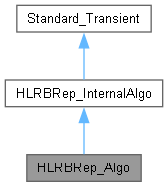
Public Member Functions | |
| HLRBRep_Algo () | |
| Constructs an empty framework for the calculation of visible and hidden lines of a shape in a projection. Use the function: | |
| HLRBRep_Algo (const occ::handle< HLRBRep_Algo > &A) | |
| void | Add (const TopoDS_Shape &S, const occ::handle< Standard_Transient > &SData, const int nbIso=0) |
| add the Shape | |
| void | Add (const TopoDS_Shape &S, const int nbIso=0) |
| Adds the shape S to this framework, and specifies the number of isoparameters nbiso desired in visualizing S. You may add as many shapes as you wish. Use the function Add once for each shape. | |
| int | Index (const TopoDS_Shape &S) |
| return the index of the Shape | |
| void | OutLinedShapeNullify () |
| nullify all the results of OutLiner from HLRTopoBRep. | |
 Public Member Functions inherited from HLRBRep_InternalAlgo Public Member Functions inherited from HLRBRep_InternalAlgo | |
| HLRBRep_InternalAlgo () | |
| HLRBRep_InternalAlgo (const occ::handle< HLRBRep_InternalAlgo > &A) | |
| void | Projector (const HLRAlgo_Projector &P) |
| set the projector. | |
| HLRAlgo_Projector & | Projector () |
| set the projector. | |
| void | Update () |
| update the DataStructure. | |
| void | Load (const occ::handle< HLRTopoBRep_OutLiner > &S, const occ::handle< Standard_Transient > &SData, const int nbIso=0) |
| add the shape | |
| void | Load (const occ::handle< HLRTopoBRep_OutLiner > &S, const int nbIso=0) |
| add the shape | |
| int | Index (const occ::handle< HLRTopoBRep_OutLiner > &S) const |
| return the index of the Shape | |
| void | Remove (const int I) |
| remove the Shape of Index . | |
| void | ShapeData (const int I, const occ::handle< Standard_Transient > &SData) |
| Change the Shape Data of the Shape of index . | |
| NCollection_Sequence< HLRBRep_ShapeBounds > & | SeqOfShapeBounds () |
| int | NbShapes () const |
| HLRBRep_ShapeBounds & | ShapeBounds (const int I) |
| void | InitEdgeStatus () |
| init the status of the selected edges depending of the back faces of a closed shell. | |
| void | Select () |
| select all the DataStructure. | |
| void | Select (const int I) |
| select only the Shape of index . | |
| void | SelectEdge (const int I) |
| select only the edges of the Shape | |
| void | SelectFace (const int I) |
| select only the faces of the Shape | |
| void | ShowAll () |
| set to visible all the edges. | |
| void | ShowAll (const int I) |
| set to visible all the edges of the Shape | |
| void | HideAll () |
| set to hide all the edges. | |
| void | HideAll (const int I) |
| set to hide all the edges of the Shape | |
| void | PartialHide () |
| own hiding of all the shapes of the DataStructure without hiding by each other. | |
| void | Hide () |
| hide all the DataStructure. | |
| void | Hide (const int I) |
| hide the Shape | |
| void | Hide (const int I, const int J) |
| hide the Shape <S1> by the shape <S2>. | |
| void | Debug (const bool deb) |
| bool | Debug () const |
| occ::handle< HLRBRep_Data > | DataStructure () const |
| Public Member Functions inherited from Standard_Transient | |
| Standard_Transient () | |
| Empty constructor. | |
| Standard_Transient (const Standard_Transient &) | |
| Copy constructor – does nothing. | |
| Standard_Transient & | operator= (const Standard_Transient &) |
| Assignment operator, needed to avoid copying reference counter. | |
| virtual | ~Standard_Transient ()=default |
| Destructor must be virtual. | |
| virtual const opencascade::handle< Standard_Type > & | DynamicType () const |
| Returns a type descriptor about this object. | |
| bool | IsInstance (const opencascade::handle< Standard_Type > &theType) const |
| Returns a true value if this is an instance of Type. | |
| bool | IsInstance (const char *const theTypeName) const |
| Returns a true value if this is an instance of TypeName. | |
| bool | IsKind (const opencascade::handle< Standard_Type > &theType) const |
| Returns true if this is an instance of Type or an instance of any class that inherits from Type. Note that multiple inheritance is not supported by OCCT RTTI mechanism. | |
| bool | IsKind (const char *const theTypeName) const |
| Returns true if this is an instance of TypeName or an instance of any class that inherits from TypeName. Note that multiple inheritance is not supported by OCCT RTTI mechanism. | |
| Standard_Transient * | This () const |
| Returns non-const pointer to this object (like const_cast). For protection against creating handle to objects allocated in stack or call from constructor, it will raise exception Standard_ProgramError if reference counter is zero. | |
| int | GetRefCount () const noexcept |
| Get the reference counter of this object. | |
| void | IncrementRefCounter () noexcept |
| Increments the reference counter of this object. Uses relaxed memory ordering since incrementing only requires atomicity, not synchronization with other memory operations. | |
| int | DecrementRefCounter () noexcept |
| Decrements the reference counter of this object; returns the decremented value. Uses release ordering for the decrement to ensure all writes to the object are visible before the count reaches zero. An acquire fence is added only when the count reaches zero, ensuring proper synchronization before deletion. This is more efficient than using acq_rel for every decrement. | |
| virtual void | Delete () const |
| Memory deallocator for transient classes. | |
Additional Inherited Members | |
| Public Types inherited from Standard_Transient | |
| typedef void | base_type |
| Returns a type descriptor about this object. | |
| Static Public Member Functions inherited from Standard_Transient | |
| static constexpr const char * | get_type_name () |
| Returns a type descriptor about this object. | |
| static const opencascade::handle< Standard_Type > & | get_type_descriptor () |
| Returns type descriptor of Standard_Transient class. | |
Inherited from InternalAlgo to provide methods with Shape from TopoDS. A framework to compute a shape as seen in a projection plane. This is done by calculating the visible and the hidden parts of the shape. HLRBRep_Algo works with three types of entity:
| HLRBRep_Algo::HLRBRep_Algo | ( | ) |
Constructs an empty framework for the calculation of visible and hidden lines of a shape in a projection. Use the function:
| HLRBRep_Algo::HLRBRep_Algo | ( | const occ::handle< HLRBRep_Algo > & | A | ) |
| void HLRBRep_Algo::Add | ( | const TopoDS_Shape & | S, |
| const int | nbIso = 0 ) |
Adds the shape S to this framework, and specifies the number of isoparameters nbiso desired in visualizing S. You may add as many shapes as you wish. Use the function Add once for each shape.
| void HLRBRep_Algo::Add | ( | const TopoDS_Shape & | S, |
| const occ::handle< Standard_Transient > & | SData, | ||
| const int | nbIso = 0 ) |
add the Shape .
| int HLRBRep_Algo::Index | ( | const TopoDS_Shape & | S | ) |
return the index of the Shape and return 0 if the Shape is not found.
| void HLRBRep_Algo::OutLinedShapeNullify | ( | ) |
nullify all the results of OutLiner from HLRTopoBRep.
 1.10.0