 |
Open CASCADE Technology Reference Manual 8.0.0
|
Loading...
Searching...
No Matches
|
Open CASCADE Technology Reference Manual 8.0.0
|
A SelectExplore determines from an input list of Entities, a list obtained by a way of exploration. This implies the possibility of recursive exploration : the output list is itself reused as input, etc... Examples : Shared Entities, can be considered at one level (immediate shared) or more, or max level. More...
#include <IFSelect_SelectExplore.hxx>
Public Member Functions | |
| int | Level () const |
| Returns the required exploring level. | |
| Interface_EntityIterator | RootResult (const Interface_Graph &G) const override |
| Returns the list of selected entities. Works by calling the method Explore on each input entity : it can be rejected, taken for output, or to explore. If the maximum level has not yet been attained, or if no max level is specified, entities to be explored are themselves used as if they were input. | |
| virtual bool | Explore (const int level, const occ::handle< Standard_Transient > &ent, const Interface_Graph &G, Interface_EntityIterator &explored) const =0 |
| Analyses and, if required, Explores an entity, as follows : The explored list starts as empty, it has to be filled by this method. If it returns False, <ent> is rejected for result (this is to be used only as safety) If it returns True and <explored> remains empty, <ent> is taken itself for result, not explored If it returns True and <explored> is not empty, the content of this list is considered : If maximum level is attained, it is taken for result Else (or no max), each of its entity will be itself explored. | |
| TCollection_AsciiString | Label () const override |
| Returns a text saying "(Recursive)" or "(Level nn)" plus specific criterium returned by ExploreLabel (see below) | |
| virtual TCollection_AsciiString | ExploreLabel () const =0 |
| Returns a text defining the way of exploration. | |
 Public Member Functions inherited from IFSelect_SelectDeduct Public Member Functions inherited from IFSelect_SelectDeduct | |
| void | SetInput (const occ::handle< IFSelect_Selection > &sel) |
| Defines or Changes the Input Selection. | |
| occ::handle< IFSelect_Selection > | Input () const |
| Returns the Input Selection. | |
| bool | HasInput () const |
| Returns True if the Input Selection is defined, False else. | |
| bool | HasAlternate () const |
| Tells if an Alternate List has been set, i.e. : the Alternate Definition is present and set. | |
| occ::handle< IFSelect_SelectPointed > & | Alternate () |
| Returns the Alternate Definition It is returned modifiable, hence an already defined SelectPointed can be used But if it was not yet defined, it is created the first time. | |
| Interface_EntityIterator | InputResult (const Interface_Graph &G) const |
| Returns the Result determined by Input Selection, as Unique if Input Selection is not defined, returns an empty list. | |
| void | FillIterator (IFSelect_SelectionIterator &iter) const override |
| Puts in an Iterator the Selections from which "me" depends This list contains one Selection : the InputSelection. | |
| Public Member Functions inherited from IFSelect_Selection | |
| Interface_EntityIterator | UniqueResult (const Interface_Graph &G) const |
| Returns the list of selected entities, each of them being unique. Default definition works from RootResult. According HasUniqueResult, UniqueResult returns directly RootResult, or build a Unique Result from it with a Graph. | |
| virtual Interface_EntityIterator | CompleteResult (const Interface_Graph &G) const |
| Returns the list of entities involved by a Selection, i.e. UniqueResult plus the shared entities (directly or not) | |
| Public Member Functions inherited from Standard_Transient | |
| Standard_Transient () | |
| Empty constructor. | |
| Standard_Transient (const Standard_Transient &) | |
| Copy constructor – does nothing. | |
| Standard_Transient & | operator= (const Standard_Transient &) |
| Assignment operator, needed to avoid copying reference counter. | |
| virtual | ~Standard_Transient ()=default |
| Destructor must be virtual. | |
| virtual const opencascade::handle< Standard_Type > & | DynamicType () const |
| Returns a type descriptor about this object. | |
| bool | IsInstance (const opencascade::handle< Standard_Type > &theType) const |
| Returns a true value if this is an instance of Type. | |
| bool | IsInstance (const char *const theTypeName) const |
| Returns a true value if this is an instance of TypeName. | |
| bool | IsKind (const opencascade::handle< Standard_Type > &theType) const |
| Returns true if this is an instance of Type or an instance of any class that inherits from Type. Note that multiple inheritance is not supported by OCCT RTTI mechanism. | |
| bool | IsKind (const char *const theTypeName) const |
| Returns true if this is an instance of TypeName or an instance of any class that inherits from TypeName. Note that multiple inheritance is not supported by OCCT RTTI mechanism. | |
| Standard_Transient * | This () const |
| Returns non-const pointer to this object (like const_cast). For protection against creating handle to objects allocated in stack or call from constructor, it will raise exception Standard_ProgramError if reference counter is zero. | |
| int | GetRefCount () const noexcept |
| Get the reference counter of this object. | |
| void | IncrementRefCounter () noexcept |
| Increments the reference counter of this object. Uses relaxed memory ordering since incrementing only requires atomicity, not synchronization with other memory operations. | |
| int | DecrementRefCounter () noexcept |
| Decrements the reference counter of this object; returns the decremented value. Uses release ordering for the decrement to ensure all writes to the object are visible before the count reaches zero. An acquire fence is added only when the count reaches zero, ensuring proper synchronization before deletion. This is more efficient than using acq_rel for every decrement. | |
| virtual void | Delete () const |
| Memory deallocator for transient classes. | |
Protected Member Functions | |
| IFSelect_SelectExplore (const int level) | |
| Initializes a SelectExplore : the level must be specified on starting. 0 means all levels, 1 means level one only, etc... | |
| Protected Member Functions inherited from IFSelect_Selection | |
| virtual bool | HasUniqueResult () const |
| Returns True if RootResult guarantees uniqueness for each Entity. Called by UniqueResult. Default answer is False. Can be redefined. | |
Additional Inherited Members | |
| Public Types inherited from Standard_Transient | |
| typedef void | base_type |
| Returns a type descriptor about this object. | |
| Static Public Member Functions inherited from Standard_Transient | |
| static constexpr const char * | get_type_name () |
| Returns a type descriptor about this object. | |
| static const opencascade::handle< Standard_Type > & | get_type_descriptor () |
| Returns type descriptor of Standard_Transient class. | |
A SelectExplore determines from an input list of Entities, a list obtained by a way of exploration. This implies the possibility of recursive exploration : the output list is itself reused as input, etc... Examples : Shared Entities, can be considered at one level (immediate shared) or more, or max level.
Then, for each input entity, if it is not rejected, it can be either taken itself, or explored : it then produces a list. According to a level, either the produced lists or taken entities give the result (level one), or lists are themselves considered and for each item, is it taken or explored.
Remark that rejection is just a safety : normally, an input entity is, either taken itself, or explored A maximum level can be specified. Else, the process continues until all entities have been either taken or rejected
|
protected |
Initializes a SelectExplore : the level must be specified on starting. 0 means all levels, 1 means level one only, etc...
|
pure virtual |
Analyses and, if required, Explores an entity, as follows : The explored list starts as empty, it has to be filled by this method. If it returns False, <ent> is rejected for result (this is to be used only as safety) If it returns True and <explored> remains empty, <ent> is taken itself for result, not explored If it returns True and <explored> is not empty, the content of this list is considered : If maximum level is attained, it is taken for result Else (or no max), each of its entity will be itself explored.
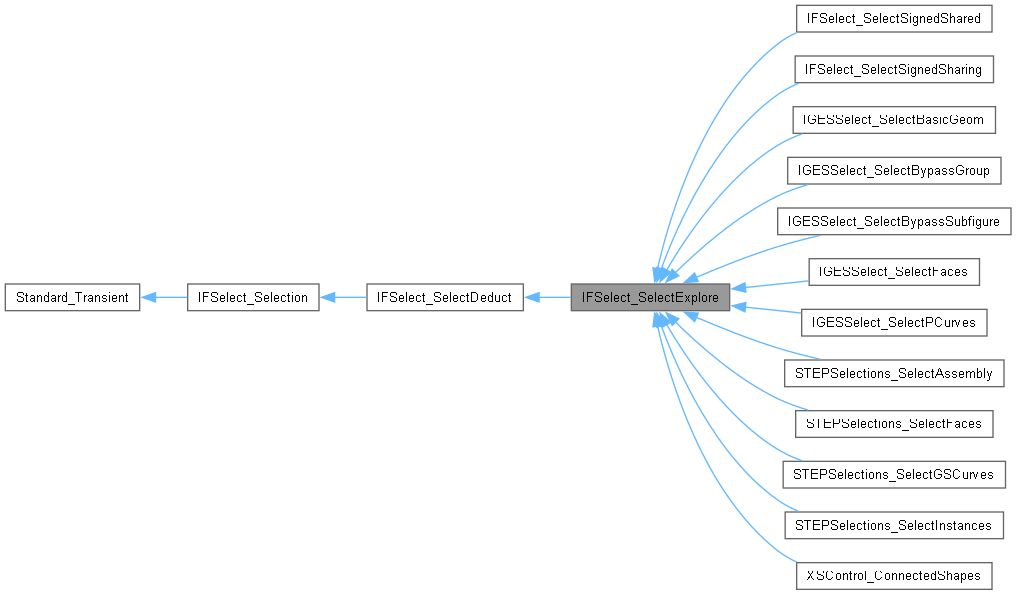
Implemented in IGESSelect_SelectBasicGeom, IGESSelect_SelectBypassGroup, IGESSelect_SelectBypassSubfigure, IGESSelect_SelectFaces, IGESSelect_SelectPCurves, STEPSelections_SelectAssembly, STEPSelections_SelectFaces, STEPSelections_SelectGSCurves, STEPSelections_SelectInstances, IFSelect_SelectSignedShared, IFSelect_SelectSignedSharing, and XSControl_ConnectedShapes.
|
pure virtual |
Returns a text defining the way of exploration.
Implemented in IGESSelect_SelectBasicGeom, IGESSelect_SelectBypassGroup, IGESSelect_SelectBypassSubfigure, IGESSelect_SelectFaces, IGESSelect_SelectPCurves, STEPSelections_SelectAssembly, STEPSelections_SelectFaces, STEPSelections_SelectGSCurves, STEPSelections_SelectInstances, IFSelect_SelectSignedShared, IFSelect_SelectSignedSharing, and XSControl_ConnectedShapes.
|
overridevirtual |
Returns a text saying "(Recursive)" or "(Level nn)" plus specific criterium returned by ExploreLabel (see below)
Implements IFSelect_Selection.
| int IFSelect_SelectExplore::Level | ( | ) | const |
Returns the required exploring level.
|
overridevirtual |
Returns the list of selected entities. Works by calling the method Explore on each input entity : it can be rejected, taken for output, or to explore. If the maximum level has not yet been attained, or if no max level is specified, entities to be explored are themselves used as if they were input.
Implements IFSelect_Selection.
Reimplemented in STEPSelections_SelectInstances.
 1.10.0