|
| | Message_ProgressScope () |
| | Creates a new scope taking responsibility of the part of the progress scale described by theRange. The new scope has own range from 0 to theMax, which is mapped to the given range.
|
| |
| | Message_ProgressScope (const Message_ProgressRange &theRange, const TCollection_AsciiString &theName, double theMax, bool isInfinite=false) |
| | Creates a new scope taking responsibility of the part of the progress scale described by theRange. The new scope has own range from 0 to theMax, which is mapped to the given range.
|
| |
| template<size_t N> |
| | Message_ProgressScope (const Message_ProgressRange &theRange, const char(&theName)[N], double theMax, bool isInfinite=false) |
| | Creates a new scope taking responsibility of the part of the progress scale described by theRange. The new scope has own range from 0 to theMax, which is mapped to the given range.
|
| |
| | Message_ProgressScope (const Message_ProgressRange &theRange, const NullString *theName, double theMax, bool isInfinite=false) |
| | Creates a new scope taking responsibility of the part of the progress scale described by theRange. The new scope has own range from 0 to theMax, which is mapped to the given range.
|
| |
| void | SetName (const TCollection_AsciiString &theName) |
| | Sets the name of the scope.
|
| |
| template<size_t N> |
| void | SetName (const char(&theName)[N]) |
| | Sets the name of the scope; can be null. Note! Just pointer to the given string is copied, so do not pass string from a temporary variable whose lifetime is less than that of this object.
|
| |
| bool | UserBreak () const |
| | Returns false if ProgressIndicator signals UserBreak.
|
| |
| bool | More () const |
| | Returns false if ProgressIndicator signals UserBreak.
|
| |
| Message_ProgressRange | Next (double theStep=1.) |
| | Advances position by specified step and returns the range covering this step.
|
| |
| void | Show () |
| | Returns true if this progress scope is attached to some indicator.
|
| |
| bool | IsActive () const |
| | Returns true if this progress scope is attached to some indicator.
|
| |
| const char * | Name () const |
| | Returns the name of the scope (may be null). Scopes with null name (e.g. root scope) should be bypassed when reporting progress to the user.
|
| |
| const Message_ProgressScope * | Parent () const |
| | Returns parent scope (null for top-level scope)
|
| |
| double | MaxValue () const |
| | Returns the maximal value of progress in this scope.
|
| |
| double | Value () const |
| | Returns the current value of progress in this scope.
|
| |
| bool | IsInfinite () const |
| | Returns the infinite flag.
|
| |
| double | GetPortion () const |
| | Get the portion of the indicator covered by this scope (from 0 to 1)
|
| |
| | ~Message_ProgressScope () |
| | Closes the scope and advances the progress to its end. Closed scope should not be used.
|
| |
| void | Close () |
| | Closes the scope and advances the progress to its end. Closed scope should not be used.
|
| |
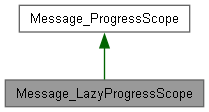
Progress scope with lazy updates and abort fetches.
Although Message_ProgressIndicator implementation is encouraged to spare GUI updates, even optimized implementation might show a noticeable overhead on a very small update step (e.g. per triangle).
The class splits initial (displayed) number of overall steps into larger chunks specified in constructor, so that displayed progress is updated at larger steps.

 1.10.0
 Protected Member Functions inherited from