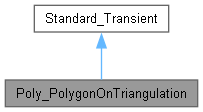
This class provides a polygon in 3D space, based on the triangulation of a surface. It may be the approximate representation of a curve on the surface, or more generally the shape. A PolygonOnTriangulation is defined by a table of nodes. Each node is an index in the table of nodes specific to a triangulation, and represents a point on the surface. If the polygon is closed, the index of the point of closure is repeated at the end of the table of nodes. If the polygon is an approximate representation of a curve on a surface, you can associate with each of its nodes the value of the parameter of the corresponding point on the curve.represents a 3d Polygon.
More...
|
| | Poly_PolygonOnTriangulation (const int theNbNodes, const bool theHasParams) |
| | Constructs a 3D polygon on the triangulation of a shape with specified size of nodes.
|
| |
| | Poly_PolygonOnTriangulation (const NCollection_Array1< int > &Nodes) |
| | Constructs a 3D polygon on the triangulation of a shape, defined by the table of nodes, <Nodes>.
|
| |
| | Poly_PolygonOnTriangulation (const NCollection_Array1< int > &Nodes, const NCollection_Array1< double > &Parameters) |
| | Constructs a 3D polygon on the triangulation of a shape, defined by:
|
| |
| virtual occ::handle< Poly_PolygonOnTriangulation > | Copy () const |
| | Creates a copy of current polygon.
|
| |
| double | Deflection () const |
| | Returns the deflection of this polygon.
|
| |
| void | Deflection (const double theDefl) |
| | Sets the deflection of this polygon. See more on deflection in Poly_Polygones2D.
|
| |
| int | NbNodes () const |
| | Returns the number of nodes for this polygon. Note: If the polygon is closed, the point of closure is repeated at the end of its table of nodes. Thus, on a closed triangle, the function NbNodes returns 4.
|
| |
| int | Node (int theIndex) const |
| | Returns node at the given index.
|
| |
| void | SetNode (int theIndex, int theNode) |
| | Sets node at the given index.
|
| |
| bool | HasParameters () const |
| | Returns true if parameters are associated with the nodes in this polygon.
|
| |
| double | Parameter (int theIndex) const |
| | Returns parameter at the given index.
|
| |
| void | SetParameter (int theIndex, double theValue) |
| | Sets parameter at the given index.
|
| |
| void | SetParameters (const occ::handle< NCollection_HArray1< double > > &theParameters) |
| | Sets the table of the parameters associated with each node in this polygon. Raises exception if array size doesn't much number of polygon nodes.
|
| |
| virtual void | DumpJson (Standard_OStream &theOStream, int theDepth=-1) const |
| | Dumps the content of me into the stream.
|
| |
| const NCollection_Array1< int > & | Nodes () const |
| | Returns the table of nodes for this polygon. A node value is an index in the table of nodes specific to an existing triangulation of a shape.
|
| |
| const occ::handle< NCollection_HArray1< double > > & | Parameters () const |
| | Returns the table of the parameters associated with each node in this polygon. Warning! Use the function HasParameters to check if parameters are associated with the nodes in this polygon.
|
| |
| NCollection_Array1< int > & | ChangeNodes () |
| |
| NCollection_Array1< double > & | ChangeParameters () |
| |
 Public Member Functions inherited from Standard_Transient Public Member Functions inherited from Standard_Transient |
| | Standard_Transient () |
| | Empty constructor.
|
| |
| | Standard_Transient (const Standard_Transient &) |
| | Copy constructor – does nothing.
|
| |
| Standard_Transient & | operator= (const Standard_Transient &) |
| | Assignment operator, needed to avoid copying reference counter.
|
| |
| virtual | ~Standard_Transient ()=default |
| | Destructor must be virtual.
|
| |
| virtual const opencascade::handle< Standard_Type > & | DynamicType () const |
| | Returns a type descriptor about this object.
|
| |
| bool | IsInstance (const opencascade::handle< Standard_Type > &theType) const |
| | Returns a true value if this is an instance of Type.
|
| |
| bool | IsInstance (const char *const theTypeName) const |
| | Returns a true value if this is an instance of TypeName.
|
| |
| bool | IsKind (const opencascade::handle< Standard_Type > &theType) const |
| | Returns true if this is an instance of Type or an instance of any class that inherits from Type. Note that multiple inheritance is not supported by OCCT RTTI mechanism.
|
| |
| bool | IsKind (const char *const theTypeName) const |
| | Returns true if this is an instance of TypeName or an instance of any class that inherits from TypeName. Note that multiple inheritance is not supported by OCCT RTTI mechanism.
|
| |
| Standard_Transient * | This () const |
| | Returns non-const pointer to this object (like const_cast). For protection against creating handle to objects allocated in stack or call from constructor, it will raise exception Standard_ProgramError if reference counter is zero.
|
| |
| int | GetRefCount () const noexcept |
| | Get the reference counter of this object.
|
| |
| void | IncrementRefCounter () noexcept |
| | Increments the reference counter of this object. Uses relaxed memory ordering since incrementing only requires atomicity, not synchronization with other memory operations.
|
| |
| int | DecrementRefCounter () noexcept |
| | Decrements the reference counter of this object; returns the decremented value. Uses release ordering for the decrement to ensure all writes to the object are visible before the count reaches zero. An acquire fence is added only when the count reaches zero, ensuring proper synchronization before deletion. This is more efficient than using acq_rel for every decrement.
|
| |
| virtual void | Delete () const |
| | Memory deallocator for transient classes.
|
| |
This class provides a polygon in 3D space, based on the triangulation of a surface. It may be the approximate representation of a curve on the surface, or more generally the shape. A PolygonOnTriangulation is defined by a table of nodes. Each node is an index in the table of nodes specific to a triangulation, and represents a point on the surface. If the polygon is closed, the index of the point of closure is repeated at the end of the table of nodes. If the polygon is an approximate representation of a curve on a surface, you can associate with each of its nodes the value of the parameter of the corresponding point on the curve.represents a 3d Polygon.

 1.10.0