 |
Open CASCADE Technology Reference Manual 8.0.0
|
Loading...
Searching...
No Matches
|
Open CASCADE Technology Reference Manual 8.0.0
|
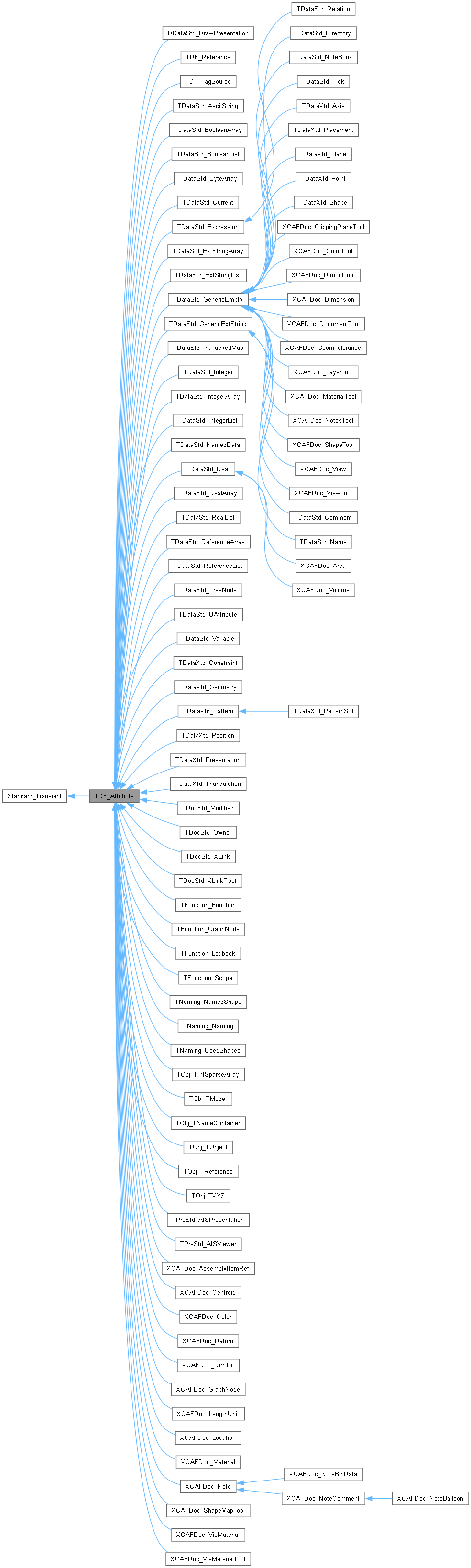
A class each application has to implement. It is used to contain the application data. This abstract class, alongwith Label, is one of the cornerstones of Model Editor. The groundwork is to define the root of information. This information is to be attached to a Label, and could be of any of the following types: More...
#include <TDF_Attribute.hxx>
Public Member Functions | |
| virtual const Standard_GUID & | ID () const =0 |
| Returns the ID of the attribute. | |
| virtual void | SetID (const Standard_GUID &) |
| Sets specific ID of the attribute (supports several attributes of one type at the same label feature). | |
| virtual void | SetID () |
| Sets default ID defined in nested class (to be used for attributes having User ID feature). | |
| const TDF_Label | Label () const |
| Returns the label to which the attribute is attached. If the label is not included in a DF, the label is null. See Label. Warning: If the label is not included in a data framework, it is null. This function should not be redefined inline. | |
| int | Transaction () const |
| Returns the transaction index in which the attribute has been created or modified. | |
| int | UntilTransaction () const |
| Returns the upper transaction index until which the attribute is/was valid. This number may vary. A removed attribute validity range is reduced to its transaction index. | |
| bool | IsValid () const |
| Returns true if the attribute is valid; i.e. not a backuped or removed one. | |
| bool | IsNew () const |
| Returns true if the attribute has no backup. | |
| bool | IsForgotten () const |
| Returns true if the attribute forgotten status is set. | |
| bool | IsAttribute (const Standard_GUID &anID) const |
| Returns true if it exists an associated attribute of <me> with <anID> as ID. | |
| bool | FindAttribute (const Standard_GUID &anID, occ::handle< TDF_Attribute > &anAttribute) const |
| Finds an associated attribute of <me>, according to <anID>. the returned <anAttribute> is a valid one. The method returns True if found, False otherwise. A removed attribute cannot be found using this method. | |
| template<class T > | |
| bool | FindAttribute (const Standard_GUID &theID, occ::handle< T > &theAttr) const |
| Safe variant for arbitrary type of argument. | |
| void | AddAttribute (const occ::handle< TDF_Attribute > &other) const |
| Adds an Attribute <other> to the label of <me>. Raises if there is already one of the same GUID than <other>. | |
| bool | ForgetAttribute (const Standard_GUID &aguid) const |
| Forgets the Attribute of GUID <aguid> associated to the label of <me>. Be careful that if <me> is the attribute of <guid>, <me> will have a null label after this call. If the attribute doesn't exist returns False. Otherwise returns True. | |
| void | ForgetAllAttributes (const bool clearChildren=true) const |
| Forgets all the attributes attached to the label of <me>. Does it on the sub-labels if <clearChildren> is set to true. Of course, this method is compatible with Transaction & Delta mechanisms. Be careful that if <me> will have a null label after this call. | |
| virtual void | AfterAddition () |
| Something to do after adding an Attribute to a label. | |
| virtual void | BeforeRemoval () |
| Something to do before removing an Attribute from a label. | |
| virtual void | BeforeForget () |
| Something to do before forgetting an Attribute to a label. | |
| virtual void | AfterResume () |
| Something to do after resuming an Attribute from a label. | |
| virtual bool | AfterRetrieval (const bool forceIt=false) |
| Something to do AFTER creation of an attribute by persistent-transient translation. The returned status says if AfterUndo has been performed (true) or if this callback must be called once again further (false). If <forceIt> is set to true, the method MUST perform and return true. Does nothing by default and returns true. | |
| virtual bool | BeforeUndo (const occ::handle< TDF_AttributeDelta > &anAttDelta, const bool forceIt=false) |
| Something to do before applying <anAttDelta>. The returned status says if AfterUndo has been performed (true) or if this callback must be called once again further (false). If <forceIt> is set to true, the method MUST perform and return true. Does nothing by default and returns true. | |
| virtual bool | AfterUndo (const occ::handle< TDF_AttributeDelta > &anAttDelta, const bool forceIt=false) |
| Something to do after applying <anAttDelta>. The returned status says if AfterUndo has been performed (true) or if this callback must be called once again further (false). If <forceIt> is set to true, the method MUST perform and return true. Does nothing by default and returns true. | |
| virtual void | BeforeCommitTransaction () |
| A callback. By default does nothing. It is called by TDF_Data::CommitTransaction() method. | |
| void | Backup () |
| Backups the attribute. The backuped attribute is flagged "Backuped" and not "Valid". | |
| bool | IsBackuped () const |
| Returns true if the attribute backup status is set. This status is set/unset by the Backup() method. | |
| virtual occ::handle< TDF_Attribute > | BackupCopy () const |
| Copies the attribute contents into a new other attribute. It is used by Backup(). | |
| virtual void | Restore (const occ::handle< TDF_Attribute > &anAttribute)=0 |
| Restores the backuped contents from <anAttribute> into this one. It is used when aborting a transaction. | |
| virtual occ::handle< TDF_DeltaOnAddition > | DeltaOnAddition () const |
| Makes an AttributeDelta because <me> appeared. The only known use of a redefinition of this method is to return a null handle (no delta). | |
| virtual occ::handle< TDF_DeltaOnForget > | DeltaOnForget () const |
| Makes an AttributeDelta because <me> has been forgotten. | |
| virtual occ::handle< TDF_DeltaOnResume > | DeltaOnResume () const |
| Makes an AttributeDelta because <me> has been resumed. | |
| virtual occ::handle< TDF_DeltaOnModification > | DeltaOnModification (const occ::handle< TDF_Attribute > &anOldAttribute) const |
| Makes a DeltaOnModification between <me> and. | |
| virtual void | DeltaOnModification (const occ::handle< TDF_DeltaOnModification > &aDelta) |
| Applies a DeltaOnModification to <me>. | |
| virtual occ::handle< TDF_DeltaOnRemoval > | DeltaOnRemoval () const |
| Makes a DeltaOnRemoval on <me> because <me> has disappeared from the DS. | |
| virtual occ::handle< TDF_Attribute > | NewEmpty () const =0 |
| Returns an new empty attribute from the good end type. It is used by the copy algorithm. | |
| virtual void | Paste (const occ::handle< TDF_Attribute > &intoAttribute, const occ::handle< TDF_RelocationTable > &aRelocationTable) const =0 |
| This method is different from the "Copy" one, because it is used when copying an attribute from a source structure into a target structure. This method may paste the contents of <me> into <intoAttribute>. | |
| virtual void | References (const occ::handle< TDF_DataSet > &aDataSet) const |
| Adds the first level referenced attributes and labels to <aDataSet>. | |
| virtual Standard_OStream & | Dump (Standard_OStream &anOS) const |
| Dumps the minimum information about <me> on <aStream>. | |
| Standard_OStream & | operator<< (Standard_OStream &anOS) const |
| virtual void | ExtendedDump (Standard_OStream &anOS, const TDF_IDFilter &aFilter, NCollection_IndexedMap< occ::handle< TDF_Attribute > > &aMap) const |
| Dumps the attribute content on <aStream>, using <aMap> like this: if an attribute is not in the map, first put add it to the map and then dump it. Use the map rank instead of dumping each attribute field. | |
| void | Forget (const int aTransaction) |
| Forgets the attribute. <aTransaction> is the current transaction in which the forget is done. A forgotten attribute is also flagged not "Valid". | |
| virtual void | DumpJson (Standard_OStream &theOStream, int theDepth=-1) const |
| Dumps the content of me into the stream. | |
 Public Member Functions inherited from Standard_Transient Public Member Functions inherited from Standard_Transient | |
| Standard_Transient () | |
| Empty constructor. | |
| Standard_Transient (const Standard_Transient &) | |
| Copy constructor – does nothing. | |
| Standard_Transient & | operator= (const Standard_Transient &) |
| Assignment operator, needed to avoid copying reference counter. | |
| virtual | ~Standard_Transient ()=default |
| Destructor must be virtual. | |
| virtual const opencascade::handle< Standard_Type > & | DynamicType () const |
| Returns a type descriptor about this object. | |
| bool | IsInstance (const opencascade::handle< Standard_Type > &theType) const |
| Returns a true value if this is an instance of Type. | |
| bool | IsInstance (const char *const theTypeName) const |
| Returns a true value if this is an instance of TypeName. | |
| bool | IsKind (const opencascade::handle< Standard_Type > &theType) const |
| Returns true if this is an instance of Type or an instance of any class that inherits from Type. Note that multiple inheritance is not supported by OCCT RTTI mechanism. | |
| bool | IsKind (const char *const theTypeName) const |
| Returns true if this is an instance of TypeName or an instance of any class that inherits from TypeName. Note that multiple inheritance is not supported by OCCT RTTI mechanism. | |
| Standard_Transient * | This () const |
| Returns non-const pointer to this object (like const_cast). For protection against creating handle to objects allocated in stack or call from constructor, it will raise exception Standard_ProgramError if reference counter is zero. | |
| int | GetRefCount () const noexcept |
| Get the reference counter of this object. | |
| void | IncrementRefCounter () noexcept |
| Increments the reference counter of this object. Uses relaxed memory ordering since incrementing only requires atomicity, not synchronization with other memory operations. | |
| int | DecrementRefCounter () noexcept |
| Decrements the reference counter of this object; returns the decremented value. Uses release ordering for the decrement to ensure all writes to the object are visible before the count reaches zero. An acquire fence is added only when the count reaches zero, ensuring proper synchronization before deletion. This is more efficient than using acq_rel for every decrement. | |
| virtual void | Delete () const |
| Memory deallocator for transient classes. | |
Protected Member Functions | |
| TDF_Attribute () | |
| Initializes fields. | |
Additional Inherited Members | |
| Public Types inherited from Standard_Transient | |
| typedef void | base_type |
| Returns a type descriptor about this object. | |
| Static Public Member Functions inherited from Standard_Transient | |
| static constexpr const char * | get_type_name () |
| Returns a type descriptor about this object. | |
| static const opencascade::handle< Standard_Type > & | get_type_descriptor () |
| Returns type descriptor of Standard_Transient class. | |
A class each application has to implement. It is used to contain the application data. This abstract class, alongwith Label, is one of the cornerstones of Model Editor. The groundwork is to define the root of information. This information is to be attached to a Label, and could be of any of the following types:
Each software component who'd like to attach its own information to a label has to inherit from this class and has to add its own information as fields of this new class.
An attribute can be identified by its ID. Every attributes used with the same meaning (for example: Integer, String, Topology...) have the same worldwide unique ID.
An attribute can be added to a label only if there is no attribute yet with the same ID. Call-back methods are offered, called automatically before and after the addition action.
An attribute can be removed from a label only if there is an attribute yet with the same ID. Call-back methods are offered, called automatically before and after the removal action. A removed attribute cannot be found again. After a removal, only an addition of an attribute with the sane ID is possible (no backup...).
An attribute can be backuped before a modification. Only one backup attribute by transaction is possible. The modification can be forgotten (abort transaction) or validated (commit transaction).
BackupCopy and restore are methods used by the backup or abort transaction actions. BackupCopy is called by Backup to generate an attribute with the same contents as the current one. Restore is called when aborting a transaction to transfer the backuped contents into the current attribute. These methods must be implemented by end use inheriting classes.
A standard implementation of BackupCopy is provided, but it is not necessary a good one for any use.
Paste and NewEmpty methods are used by the copy algorithms. The goal of "Paste" is to transfer an attribute new contents into another attribute. The goal of "NewEmpty" is to create an attribute without contents, to be further filled with the new contents of another one. These 2 methods must be implemented by end use inheriting classes.
An AttributeDelta is the difference between to attribute values states. These methods must be implemented by end use inheriting classes, to profit from the delta services.
|
protected |
Initializes fields.
| void TDF_Attribute::AddAttribute | ( | const occ::handle< TDF_Attribute > & | other | ) | const |
Adds an Attribute <other> to the label of <me>. Raises if there is already one of the same GUID than <other>.
Something to do after adding an Attribute to a label.
Reimplemented in TDataStd_TreeNode, TDocStd_XLink, TPrsStd_AISPresentation, and DDataStd_DrawPresentation.
Something to do after resuming an Attribute from a label.
Reimplemented in TDataStd_TreeNode, TObj_TReference, TPrsStd_AISPresentation, and DDataStd_DrawPresentation.
Something to do AFTER creation of an attribute by persistent-transient translation. The returned status says if AfterUndo has been performed (true) or if this callback must be called once again further (false). If <forceIt> is set to true, the method MUST perform and return true. Does nothing by default and returns true.
Reimplemented in TObj_TReference, and XCAFDoc_DocumentTool.
|
virtual |
Something to do after applying <anAttDelta>. The returned status says if AfterUndo has been performed (true) or if this callback must be called once again further (false). If <forceIt> is set to true, the method MUST perform and return true. Does nothing by default and returns true.
Reimplemented in TObj_TObject, TNaming_NamedShape, TNaming_UsedShapes, TDataStd_TreeNode, TDocStd_XLink, TPrsStd_AISPresentation, DDataStd_DrawPresentation, TObj_TReference, and TObj_TIntSparseArray.
| void TDF_Attribute::Backup | ( | ) |
Backups the attribute. The backuped attribute is flagged "Backuped" and not "Valid".
The method does nothing:
1) If the attribute transaction number is equal to the current transaction number (the attribute has already been backuped).
2) If the attribute is not attached to a label.
|
virtual |
Copies the attribute contents into a new other attribute. It is used by Backup().
Reimplemented in TDataXtd_Presentation, TNaming_NamedShape, TNaming_UsedShapes, TDocStd_XLink, TDocStd_XLinkRoot, TObj_TIntSparseArray, and TPrsStd_AISPresentation.
A callback. By default does nothing. It is called by TDF_Data::CommitTransaction() method.
Reimplemented in TObj_TIntSparseArray.
Something to do before forgetting an Attribute to a label.
Reimplemented in TDataStd_TreeNode, TObj_TObject, TObj_TReference, TPrsStd_AISPresentation, XCAFDoc_GraphNode, and DDataStd_DrawPresentation.
Something to do before removing an Attribute from a label.
Reimplemented in TNaming_NamedShape, TNaming_UsedShapes, TDocStd_XLink, TPrsStd_AISPresentation, and DDataStd_DrawPresentation.
|
virtual |
Something to do before applying <anAttDelta>. The returned status says if AfterUndo has been performed (true) or if this callback must be called once again further (false). If <forceIt> is set to true, the method MUST perform and return true. Does nothing by default and returns true.
Reimplemented in TNaming_NamedShape, TDataStd_TreeNode, TDocStd_XLink, TPrsStd_AISPresentation, DDataStd_DrawPresentation, and TObj_TReference.
|
virtual |
Makes an AttributeDelta because <me> appeared. The only known use of a redefinition of this method is to return a null handle (no delta).
Reimplemented in TNaming_UsedShapes.
|
virtual |
Makes an AttributeDelta because <me> has been forgotten.
|
virtual |
Makes a DeltaOnModification between <me> and.
Reimplemented in TNaming_NamedShape, TDataStd_ByteArray, TDataStd_ExtStringArray, TDataStd_IntegerArray, TDataStd_IntPackedMap, and TDataStd_RealArray.
|
virtual |
Applies a DeltaOnModification to <me>.
Reimplemented in TNaming_NamedShape, and TObj_TIntSparseArray.
|
virtual |
Makes a DeltaOnRemoval on <me> because <me> has disappeared from the DS.
Reimplemented in TNaming_NamedShape, and TNaming_UsedShapes.
|
virtual |
Makes an AttributeDelta because <me> has been resumed.
|
virtual |
Dumps the minimum information about <me> on <aStream>.
Reimplemented in TDataXtd_Axis, TDataXtd_Constraint, TDataXtd_Geometry, TDataXtd_PatternStd, TDataXtd_Placement, TDataXtd_Plane, TDataXtd_Point, TDataXtd_Shape, TDataXtd_Triangulation, TNaming_NamedShape, TNaming_Naming, TNaming_UsedShapes, TDataStd_AsciiString, TDataStd_BooleanList, TDataStd_Comment, TDataStd_Current, TDataStd_Directory, TDataStd_Expression, TDataStd_ExtStringArray, TDataStd_ExtStringList, TDataStd_Integer, TDataStd_IntegerArray, TDataStd_IntegerList, TDataStd_IntPackedMap, TDataStd_Name, TDataStd_NamedData, TDataStd_NoteBook, TDataStd_Real, TDataStd_RealArray, TDataStd_RealList, TDataStd_ReferenceArray, TDataStd_ReferenceList, TDataStd_Relation, TDataStd_Tick, TDataStd_TreeNode, TDataStd_UAttribute, TDataStd_Variable, TDF_Reference, TDocStd_Modified, TDocStd_Owner, TDocStd_XLink, TDocStd_XLinkRoot, TFunction_Function, TFunction_GraphNode, TFunction_Logbook, TFunction_Scope, XCAFDoc_Area, XCAFDoc_Centroid, XCAFDoc_GraphNode, XCAFDoc_LengthUnit, XCAFDoc_Volume, TDataStd_BooleanArray, TDataStd_ByteArray, XCAFDoc_ShapeTool, TObj_TXYZ, XCAFDoc_AssemblyItemRef, XCAFDoc_Note, XCAFDoc_NoteBinData, XCAFDoc_NoteComment, and XCAFDoc_NotesTool.
|
virtual |
Dumps the content of me into the stream.
Reimplemented in TNaming_NamedShape, TNaming_Naming, TNaming_UsedShapes, TDataStd_AsciiString, TDataStd_BooleanArray, TDataStd_BooleanList, TDataStd_ByteArray, TDataStd_Current, TDataStd_Expression, TDataStd_ExtStringArray, TDataStd_ExtStringList, TDataStd_GenericEmpty, TDataStd_GenericExtString, TDataStd_Integer, TDataStd_IntegerArray, TDataStd_IntegerList, TDataStd_IntPackedMap, TDataStd_NamedData, TDataStd_Real, TDataStd_RealArray, TDataStd_RealList, TDataStd_ReferenceArray, TDataStd_ReferenceList, TDataStd_Relation, TDataStd_TreeNode, TDataStd_UAttribute, TDataStd_Variable, TDF_Reference, TDF_TagSource, TDocStd_Owner, TFunction_Function, TPrsStd_AISPresentation, TPrsStd_AISViewer, XCAFDoc_Area, XCAFDoc_AssemblyItemRef, XCAFDoc_Centroid, XCAFDoc_Color, XCAFDoc_ColorTool, XCAFDoc_Datum, XCAFDoc_Dimension, XCAFDoc_DimTol, XCAFDoc_DimTolTool, XCAFDoc_GeomTolerance, XCAFDoc_GraphNode, XCAFDoc_LayerTool, XCAFDoc_LengthUnit, XCAFDoc_Location, XCAFDoc_Material, XCAFDoc_MaterialTool, XCAFDoc_Note, XCAFDoc_ShapeMapTool, XCAFDoc_ShapeTool, XCAFDoc_VisMaterial, and XCAFDoc_Volume.
|
virtual |
Dumps the attribute content on <aStream>, using <aMap> like this: if an attribute is not in the map, first put add it to the map and then dump it. Use the map rank instead of dumping each attribute field.
Reimplemented in TNaming_Naming.
| bool TDF_Attribute::FindAttribute | ( | const Standard_GUID & | anID, |
| occ::handle< TDF_Attribute > & | anAttribute ) const |
Finds an associated attribute of <me>, according to <anID>. the returned <anAttribute> is a valid one. The method returns True if found, False otherwise. A removed attribute cannot be found using this method.
|
inline |
Safe variant for arbitrary type of argument.
Forgets the attribute. <aTransaction> is the current transaction in which the forget is done. A forgotten attribute is also flagged not "Valid".
A forgotten attribute is invisible. Set also the "Valid" status to False. Obviously, DF cannot empty an attribute (this has a semantic signification), but can remove it from the structure. So, a forgotten attribute is NOT an empty one, but a soon DEAD one.
Should be private.
Forgets all the attributes attached to the label of <me>. Does it on the sub-labels if <clearChildren> is set to true. Of course, this method is compatible with Transaction & Delta mechanisms. Be careful that if <me> will have a null label after this call.
| bool TDF_Attribute::ForgetAttribute | ( | const Standard_GUID & | aguid | ) | const |
Forgets the Attribute of GUID <aguid> associated to the label of <me>. Be careful that if <me> is the attribute of <guid>, <me> will have a null label after this call. If the attribute doesn't exist returns False. Otherwise returns True.
|
pure virtual |
Returns the ID of the attribute.
Implemented in TDataXtd_Axis, TDataXtd_Constraint, TDataXtd_Geometry, TDataXtd_Pattern, TDataXtd_Placement, TDataXtd_Plane, TDataXtd_Point, TDataXtd_Position, TDataXtd_Presentation, TDataXtd_Shape, TDataXtd_Triangulation, TNaming_NamedShape, TNaming_Naming, TNaming_UsedShapes, TDataStd_AsciiString, TDataStd_BooleanArray, TDataStd_BooleanList, TDataStd_ByteArray, TDataStd_Current, TDataStd_Directory, TDataStd_Expression, TDataStd_ExtStringArray, TDataStd_ExtStringList, TDataStd_GenericExtString, TDataStd_Integer, TDataStd_IntegerArray, TDataStd_IntegerList, TDataStd_IntPackedMap, TDataStd_NamedData, TDataStd_NoteBook, TDataStd_Real, TDataStd_RealArray, TDataStd_RealList, TDataStd_ReferenceArray, TDataStd_ReferenceList, TDataStd_Relation, TDataStd_Tick, TDataStd_TreeNode, TDataStd_UAttribute, TDataStd_Variable, TDF_Reference, TDF_TagSource, TDocStd_Modified, TDocStd_Owner, TDocStd_XLink, TDocStd_XLinkRoot, TFunction_Function, TFunction_GraphNode, TFunction_Logbook, TFunction_Scope, TObj_TIntSparseArray, TObj_TModel, TObj_TNameContainer, TObj_TObject, TObj_TReference, TObj_TXYZ, TPrsStd_AISPresentation, TPrsStd_AISViewer, XCAFDoc_Area, XCAFDoc_AssemblyItemRef, XCAFDoc_Centroid, XCAFDoc_ClippingPlaneTool, XCAFDoc_Color, XCAFDoc_ColorTool, XCAFDoc_Datum, XCAFDoc_Dimension, XCAFDoc_DimTol, XCAFDoc_DimTolTool, XCAFDoc_DocumentTool, XCAFDoc_GeomTolerance, XCAFDoc_GraphNode, XCAFDoc_LayerTool, XCAFDoc_LengthUnit, XCAFDoc_Location, XCAFDoc_Material, XCAFDoc_MaterialTool, XCAFDoc_NoteBalloon, XCAFDoc_NoteBinData, XCAFDoc_NoteComment, XCAFDoc_NotesTool, XCAFDoc_ShapeMapTool, XCAFDoc_ShapeTool, XCAFDoc_View, XCAFDoc_ViewTool, XCAFDoc_VisMaterial, XCAFDoc_VisMaterialTool, XCAFDoc_Volume, and DDataStd_DrawPresentation.
| bool TDF_Attribute::IsAttribute | ( | const Standard_GUID & | anID | ) | const |
Returns true if it exists an associated attribute of <me> with <anID> as ID.
| bool TDF_Attribute::IsBackuped | ( | ) | const |
Returns true if the attribute backup status is set. This status is set/unset by the Backup() method.
| bool TDF_Attribute::IsForgotten | ( | ) | const |
| bool TDF_Attribute::IsNew | ( | ) | const |
Returns true if the attribute has no backup.
| bool TDF_Attribute::IsValid | ( | ) | const |
Returns true if the attribute is valid; i.e. not a backuped or removed one.
| const TDF_Label TDF_Attribute::Label | ( | ) | const |
Returns the label to which the attribute is attached. If the label is not included in a DF, the label is null. See Label. Warning: If the label is not included in a data framework, it is null. This function should not be redefined inline.
|
pure virtual |
Returns an new empty attribute from the good end type. It is used by the copy algorithm.
Implemented in TDataXtd_Constraint, TDataXtd_Geometry, TDataXtd_PatternStd, TDataXtd_Position, TDataXtd_Presentation, TDataXtd_Triangulation, TNaming_NamedShape, TNaming_Naming, TNaming_UsedShapes, TDataStd_AsciiString, TDataStd_BooleanArray, TDataStd_BooleanList, TDataStd_ByteArray, TDataStd_Current, TDataStd_Expression, TDataStd_ExtStringArray, TDataStd_ExtStringList, TDataStd_Integer, TDataStd_IntegerArray, TDataStd_IntegerList, TDataStd_IntPackedMap, TDataStd_NamedData, TDataStd_Real, TDataStd_RealArray, TDataStd_RealList, TDataStd_ReferenceArray, TDataStd_ReferenceList, TDataStd_TreeNode, TDataStd_UAttribute, TDataStd_Variable, TDF_Reference, TDF_TagSource, TDocStd_Modified, TDocStd_Owner, TDocStd_XLink, TDocStd_XLinkRoot, TFunction_Function, TFunction_GraphNode, TFunction_Logbook, TFunction_Scope, TObj_TIntSparseArray, TObj_TModel, TObj_TNameContainer, TObj_TObject, TObj_TReference, TObj_TXYZ, TPrsStd_AISPresentation, TPrsStd_AISViewer, XCAFDoc_AssemblyItemRef, XCAFDoc_Centroid, XCAFDoc_Color, XCAFDoc_Datum, XCAFDoc_DimTol, XCAFDoc_GraphNode, XCAFDoc_Location, XCAFDoc_Material, XCAFDoc_NoteBinData, XCAFDoc_NoteComment, XCAFDoc_ShapeMapTool, XCAFDoc_VisMaterial, XCAFDoc_VisMaterialTool, and DDataStd_DrawPresentation.
|
inline |
|
pure virtual |
This method is different from the "Copy" one, because it is used when copying an attribute from a source structure into a target structure. This method may paste the contents of <me> into <intoAttribute>.
The given pasted attribute can be full or empty of its contents. But don't make a NEW! Just set the contents!
It is possible to use <aRelocationTable> to get/set the relocation value of a source attribute.
Implemented in TDataStd_GenericEmpty, XCAFDoc_VisMaterialTool, TDataXtd_Constraint, TDataXtd_Geometry, TDataXtd_PatternStd, TDataXtd_Triangulation, TNaming_Naming, TDataStd_AsciiString, TDataStd_BooleanArray, TDataStd_BooleanList, TDataStd_ByteArray, TDataStd_Current, TDataStd_Expression, TDataStd_ExtStringArray, TDataStd_ExtStringList, TDataStd_GenericExtString, TDataStd_Integer, TDataStd_IntegerArray, TDataStd_IntegerList, TDataStd_IntPackedMap, TDataStd_NamedData, TDataStd_Real, TDataStd_RealArray, TDataStd_RealList, TDataStd_ReferenceArray, TDataStd_ReferenceList, TDataStd_TreeNode, TDataStd_UAttribute, TDataStd_Variable, TDF_Reference, TDF_TagSource, TDocStd_Modified, TDocStd_Owner, TFunction_Function, TFunction_GraphNode, TFunction_Logbook, TFunction_Scope, TPrsStd_AISPresentation, TPrsStd_AISViewer, XCAFDoc_Centroid, XCAFDoc_Color, XCAFDoc_Datum, XCAFDoc_DimTol, XCAFDoc_GraphNode, XCAFDoc_Location, XCAFDoc_Material, XCAFDoc_ShapeMapTool, DDataStd_DrawPresentation, TDocStd_XLink, TDocStd_XLinkRoot, TDataXtd_Position, TDataXtd_Presentation, TNaming_NamedShape, TNaming_UsedShapes, XCAFDoc_AssemblyItemRef, XCAFDoc_Note, XCAFDoc_NoteBinData, XCAFDoc_NoteComment, XCAFDoc_VisMaterial, TObj_TIntSparseArray, TObj_TModel, TObj_TNameContainer, TObj_TObject, TObj_TReference, TObj_TXYZ, and XCAFDoc_LengthUnit.
|
virtual |
Adds the first level referenced attributes and labels to <aDataSet>.
For this, use the AddLabel or AddAttribute of DataSet.
If there is none, do not implement the method.
Reimplemented in TDataXtd_PatternStd, TNaming_NamedShape, TNaming_Naming, TNaming_UsedShapes, TDataStd_TreeNode, TFunction_Function, TFunction_GraphNode, XCAFDoc_GraphNode, TDataXtd_Constraint, TDataXtd_Shape, TDataStd_ReferenceArray, TDataStd_ReferenceList, TDataStd_UAttribute, TDataStd_Variable, and TDF_Reference.
|
pure virtual |
Restores the backuped contents from <anAttribute> into this one. It is used when aborting a transaction.
Implemented in TDataStd_GenericEmpty, XCAFDoc_VisMaterialTool, TDataXtd_Position, TDataXtd_Presentation, TNaming_NamedShape, TNaming_UsedShapes, TDocStd_XLink, TDocStd_XLinkRoot, XCAFDoc_AssemblyItemRef, XCAFDoc_Note, XCAFDoc_NoteBinData, XCAFDoc_NoteComment, TDataXtd_Triangulation, TObj_TIntSparseArray, TObj_TModel, TObj_TNameContainer, TObj_TObject, TObj_TReference, TObj_TXYZ, XCAFDoc_LengthUnit, XCAFDoc_VisMaterial, TDataXtd_Constraint, TDataXtd_Geometry, TDataXtd_PatternStd, TNaming_Naming, TDataStd_AsciiString, TDataStd_BooleanArray, TDataStd_BooleanList, TDataStd_ByteArray, TDataStd_Current, TDataStd_Expression, TDataStd_ExtStringArray, TDataStd_ExtStringList, TDataStd_GenericExtString, TDataStd_Integer, TDataStd_IntegerArray, TDataStd_IntegerList, TDataStd_IntPackedMap, TDataStd_NamedData, TDataStd_Real, TDataStd_RealArray, TDataStd_RealList, TDataStd_ReferenceArray, TDataStd_ReferenceList, TDataStd_TreeNode, TDataStd_UAttribute, TDataStd_Variable, TDF_Reference, TDF_TagSource, TDocStd_Modified, TDocStd_Owner, TFunction_Function, TFunction_GraphNode, TFunction_Logbook, TFunction_Scope, TPrsStd_AISPresentation, TPrsStd_AISViewer, XCAFDoc_Centroid, XCAFDoc_Color, XCAFDoc_Datum, XCAFDoc_DimTol, XCAFDoc_GraphNode, XCAFDoc_Location, XCAFDoc_Material, XCAFDoc_ShapeMapTool, and DDataStd_DrawPresentation.
Sets default ID defined in nested class (to be used for attributes having User ID feature).
Reimplemented in TDataStd_AsciiString, TDataStd_BooleanArray, TDataStd_BooleanList, TDataStd_ByteArray, TDataStd_Comment, TDataStd_ExtStringArray, TDataStd_ExtStringList, TDataStd_Integer, TDataStd_IntegerArray, TDataStd_IntegerList, TDataStd_Name, TDataStd_Real, TDataStd_RealArray, TDataStd_RealList, TDataStd_ReferenceArray, and TDataStd_ReferenceList.
|
inlinevirtual |
Sets specific ID of the attribute (supports several attributes of one type at the same label feature).
Reimplemented in TDataStd_AsciiString, TDataStd_Comment, TDataStd_GenericExtString, TDataStd_Integer, TDataStd_Name, TDataStd_Real, TDataStd_UAttribute, TDataStd_BooleanArray, TDataStd_BooleanList, TDataStd_ByteArray, TDataStd_ExtStringArray, TDataStd_ExtStringList, TDataStd_IntegerArray, TDataStd_IntegerList, TDataStd_RealArray, TDataStd_RealList, TDataStd_ReferenceArray, and TDataStd_ReferenceList.
| int TDF_Attribute::Transaction | ( | ) | const |
Returns the transaction index in which the attribute has been created or modified.
| int TDF_Attribute::UntilTransaction | ( | ) | const |
Returns the upper transaction index until which the attribute is/was valid. This number may vary. A removed attribute validity range is reduced to its transaction index.
 1.10.0