 |
Open CASCADE Technology Reference Manual 8.0.0
|
Loading...
Searching...
No Matches
|
Open CASCADE Technology Reference Manual 8.0.0
|
#include <BlendFunc_ChAsym.hxx>
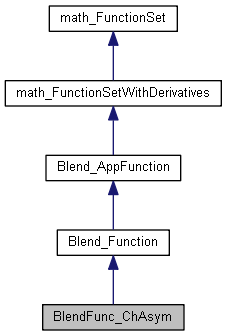
Public Member Functions | |
| BlendFunc_ChAsym (const occ::handle< Adaptor3d_Surface > &S1, const occ::handle< Adaptor3d_Surface > &S2, const occ::handle< Adaptor3d_Curve > &C) | |
| int | NbEquations () const override |
| returns the number of equations of the function. | |
| void | Set (const double Param) override |
| Sets the value of the parameter along the guide line. This determines the plane in which the solution has to be found. | |
| void | Set (const double First, const double Last) override |
| Sets the bounds of the parametric interval on the guide line. This determines the derivatives in these values if the function is not Cn. | |
| void | GetTolerance (math_Vector &Tolerance, const double Tol) const override |
| Returns in the vector Tolerance the parametric tolerance for each of the 4 variables; Tol is the tolerance used in 3d space. | |
| void | GetBounds (math_Vector &InfBound, math_Vector &SupBound) const override |
| Returns in the vector InfBound the lowest values allowed for each of the 4 variables. Returns in the vector SupBound the greatest values allowed for each of the 4 variables. | |
| bool | IsSolution (const math_Vector &Sol, const double Tol) override |
| Returns true if Sol is a zero of the function. Tol is the tolerance used in 3d space. The computation is made at the current value of the parameter on the guide line. | |
| double | GetMinimalDistance () const override |
| Returns the minimal Distance between two extremities of calculated sections. | |
| bool | ComputeValues (const math_Vector &X, const int DegF, const int DegL) |
| computes the values <F> of the derivatives for the variable <X> between DegF and DegL. Returns True if the computation was done successfully, False otherwise. | |
| bool | Value (const math_Vector &X, math_Vector &F) override |
| computes the values <F> of the Functions for the variable <X>. Returns True if the computation was done successfully, False otherwise. | |
| bool | Derivatives (const math_Vector &X, math_Matrix &D) override |
| returns the values <D> of the derivatives for the variable <X>. Returns True if the computation was done successfully, False otherwise. | |
| bool | Values (const math_Vector &X, math_Vector &F, math_Matrix &D) override |
| returns the values <F> of the functions and the derivatives <D> for the variable <X>. Returns True if the computation was done successfully, False otherwise. | |
| const gp_Pnt & | PointOnS1 () const override |
| Returns the point on the first surface, at parameter Sol(1),Sol(2) (Sol is the vector used in the call of IsSolution. | |
| const gp_Pnt & | PointOnS2 () const override |
| Returns the point on the second surface, at parameter Sol(3),Sol(4) (Sol is the vector used in the call of IsSolution. | |
| bool | IsTangencyPoint () const override |
| Returns True when it is not possible to compute the tangent vectors at PointOnS1 and/or PointOnS2. | |
| const gp_Vec & | TangentOnS1 () const override |
| Returns the tangent vector at PointOnS1, in 3d space. | |
| const gp_Vec2d & | Tangent2dOnS1 () const override |
| Returns the tangent vector at PointOnS1, in the parametric space of the first surface. | |
| const gp_Vec & | TangentOnS2 () const override |
| Returns the tangent vector at PointOnS2, in 3d space. | |
| const gp_Vec2d & | Tangent2dOnS2 () const override |
| Returns the tangent vector at PointOnS2, in the parametric space of the second surface. | |
| bool | TwistOnS1 () const override |
| bool | TwistOnS2 () const override |
| void | Tangent (const double U1, const double V1, const double U2, const double V2, gp_Vec &TgFirst, gp_Vec &TgLast, gp_Vec &NormFirst, gp_Vec &NormLast) const override |
| Returns the tangent vector at the section, at the beginning and the end of the section, and returns the normal (of the surfaces) at these points. | |
| void | Section (const double Param, const double U1, const double V1, const double U2, const double V2, double &Pdeb, double &Pfin, gp_Lin &C) |
| Utile pour une visu rapide et approximative de la surface. | |
| bool | IsRational () const override |
| Returns if the section is rational. | |
| double | GetSectionSize () const override |
| Returns the length of the maximum section. | |
| void | GetMinimalWeight (NCollection_Array1< double > &Weigths) const override |
| Compute the minimal value of weight for each poles of all sections. | |
| int | NbIntervals (const GeomAbs_Shape S) const override |
| Returns the number of intervals for continuity | |
| void | Intervals (NCollection_Array1< double > &T, const GeomAbs_Shape S) const override |
| Stores in <T> the parameters bounding the intervals of continuity | |
| void | GetShape (int &NbPoles, int &NbKnots, int &Degree, int &NbPoles2d) override |
| void | GetTolerance (const double BoundTol, const double SurfTol, const double AngleTol, math_Vector &Tol3d, math_Vector &Tol1D) const override |
| Returns the tolerance to reach in approximation to respect BoundTol error at the Boundary AngleTol tangent error at the Boundary SurfTol error inside the surface. | |
| void | Knots (NCollection_Array1< double > &TKnots) override |
| void | Mults (NCollection_Array1< int > &TMults) override |
| void | Section (const Blend_Point &P, NCollection_Array1< gp_Pnt > &Poles, NCollection_Array1< gp_Pnt2d > &Poles2d, NCollection_Array1< double > &Weigths) override |
| bool | Section (const Blend_Point &P, NCollection_Array1< gp_Pnt > &Poles, NCollection_Array1< gp_Vec > &DPoles, NCollection_Array1< gp_Pnt2d > &Poles2d, NCollection_Array1< gp_Vec2d > &DPoles2d, NCollection_Array1< double > &Weigths, NCollection_Array1< double > &DWeigths) override |
| Used for the first and last section. | |
| bool | Section (const Blend_Point &P, NCollection_Array1< gp_Pnt > &Poles, NCollection_Array1< gp_Vec > &DPoles, NCollection_Array1< gp_Vec > &D2Poles, NCollection_Array1< gp_Pnt2d > &Poles2d, NCollection_Array1< gp_Vec2d > &DPoles2d, NCollection_Array1< gp_Vec2d > &D2Poles2d, NCollection_Array1< double > &Weigths, NCollection_Array1< double > &DWeigths, NCollection_Array1< double > &D2Weigths) override |
| Used for the first and last section. | |
| void | Resolution (const int IC2d, const double Tol, double &TolU, double &TolV) const override |
| void | Set (const double Dist1, const double Angle, const int Choix) |
| Sets the distances and the angle. | |
 Public Member Functions inherited from Blend_Function Public Member Functions inherited from Blend_Function | |
| int | NbVariables () const override |
| Returns 4. | |
| const gp_Pnt & | Pnt1 () const override |
| Returns the point on the first support. | |
| const gp_Pnt & | Pnt2 () const override |
| Returns the point on the second support. | |
| Public Member Functions inherited from Blend_AppFunction | |
| double | Parameter (const Blend_Point &P) const |
| Returns the parameter of the point P. Used to impose the parameters in the approximation. | |
| Public Member Functions inherited from math_FunctionSet | |
| virtual int | GetStateNumber () |
| Returns the state of the function corresponding to the latestcall of any methods associated with the function. This function is called by each of the algorithms described later which define the function Integer Algorithm::StateNumber(). The algorithm has the responsibility to call this function when it has found a solution (i.e. a root or a minimum) and has to maintain the association between the solution found and this StateNumber. Byu default, this method returns 0 (which means for the algorithm: no state has been saved). It is the responsibility of the programmer to decide if he needs to save the current state of the function and to return an Integer that allows retrieval of the state. | |
| virtual | ~math_FunctionSet () |
| BlendFunc_ChAsym::BlendFunc_ChAsym | ( | const occ::handle< Adaptor3d_Surface > & | S1, |
| const occ::handle< Adaptor3d_Surface > & | S2, | ||
| const occ::handle< Adaptor3d_Curve > & | C ) |
| bool BlendFunc_ChAsym::ComputeValues | ( | const math_Vector & | X, |
| const int | DegF, | ||
| const int | DegL ) |
computes the values <F> of the derivatives for the variable <X> between DegF and DegL. Returns True if the computation was done successfully, False otherwise.
|
overridevirtual |
returns the values <D> of the derivatives for the variable <X>. Returns True if the computation was done successfully, False otherwise.
Implements Blend_AppFunction.
|
overridevirtual |
Returns in the vector InfBound the lowest values allowed for each of the 4 variables. Returns in the vector SupBound the greatest values allowed for each of the 4 variables.
Implements Blend_AppFunction.
|
overridevirtual |
Returns the minimal Distance between two extremities of calculated sections.
Implements Blend_AppFunction.
|
overridevirtual |
Compute the minimal value of weight for each poles of all sections.
Implements Blend_AppFunction.
|
overridevirtual |
Returns the length of the maximum section.
Implements Blend_AppFunction.
|
overridevirtual |
Implements Blend_AppFunction.
|
overridevirtual |
Returns the tolerance to reach in approximation to respect BoundTol error at the Boundary AngleTol tangent error at the Boundary SurfTol error inside the surface.
Implements Blend_AppFunction.
|
overridevirtual |
Returns in the vector Tolerance the parametric tolerance for each of the 4 variables; Tol is the tolerance used in 3d space.
Implements Blend_AppFunction.
|
overridevirtual |
Stores in <T> the parameters bounding the intervals of continuity .
The array must provide enough room to accommodate for the parameters. i.e. T.Length() > NbIntervals()
Implements Blend_AppFunction.
|
overridevirtual |
Returns if the section is rational.
Implements Blend_AppFunction.
|
overridevirtual |
Returns true if Sol is a zero of the function. Tol is the tolerance used in 3d space. The computation is made at the current value of the parameter on the guide line.
Implements Blend_AppFunction.
|
overridevirtual |
Returns True when it is not possible to compute the tangent vectors at PointOnS1 and/or PointOnS2.
Implements Blend_Function.
|
overridevirtual |
Implements Blend_AppFunction.
|
overridevirtual |
Implements Blend_AppFunction.
|
overridevirtual |
returns the number of equations of the function.
Implements Blend_AppFunction.
|
overridevirtual |
Returns the number of intervals for continuity . May be one if Continuity(me) >=
Implements Blend_AppFunction.
|
overridevirtual |
Returns the point on the first surface, at parameter Sol(1),Sol(2) (Sol is the vector used in the call of IsSolution.
Implements Blend_Function.
|
overridevirtual |
Returns the point on the second surface, at parameter Sol(3),Sol(4) (Sol is the vector used in the call of IsSolution.
Implements Blend_Function.
|
overridevirtual |
Implements Blend_AppFunction.
|
overridevirtual |
Implements Blend_Function.
|
overridevirtual |
Used for the first and last section.
Implements Blend_AppFunction.
|
overridevirtual |
Used for the first and last section.
Reimplemented from Blend_Function.
| void BlendFunc_ChAsym::Section | ( | const double | Param, |
| const double | U1, | ||
| const double | V1, | ||
| const double | U2, | ||
| const double | V2, | ||
| double & | Pdeb, | ||
| double & | Pfin, | ||
| gp_Lin & | C ) |
Utile pour une visu rapide et approximative de la surface.
Sets the distances and the angle.
Sets the bounds of the parametric interval on the guide line. This determines the derivatives in these values if the function is not Cn.
Implements Blend_AppFunction.
Sets the value of the parameter along the guide line. This determines the plane in which the solution has to be found.
Implements Blend_AppFunction.
|
overridevirtual |
Returns the tangent vector at the section, at the beginning and the end of the section, and returns the normal (of the surfaces) at these points.
Implements Blend_Function.
|
overridevirtual |
Returns the tangent vector at PointOnS1, in the parametric space of the first surface.
Implements Blend_Function.
|
overridevirtual |
Returns the tangent vector at PointOnS2, in the parametric space of the second surface.
Implements Blend_Function.
|
overridevirtual |
Returns the tangent vector at PointOnS1, in 3d space.
Implements Blend_Function.
|
overridevirtual |
Returns the tangent vector at PointOnS2, in 3d space.
Implements Blend_Function.
|
overridevirtual |
Reimplemented from Blend_Function.
|
overridevirtual |
Reimplemented from Blend_Function.
|
overridevirtual |
computes the values <F> of the Functions for the variable <X>. Returns True if the computation was done successfully, False otherwise.
Implements Blend_AppFunction.
|
overridevirtual |
returns the values <F> of the functions and the derivatives <D> for the variable <X>. Returns True if the computation was done successfully, False otherwise.
Implements Blend_AppFunction.
 1.10.0