 |
Open CASCADE Technology Reference Manual 8.0.0
|
Loading...
Searching...
No Matches
|
Open CASCADE Technology Reference Manual 8.0.0
|
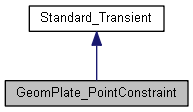
Defines points as constraints to be used to deform a surface. More...
#include <GeomPlate_PointConstraint.hxx>
Public Member Functions | |
| GeomPlate_PointConstraint (const gp_Pnt &Pt, const int Order, const double TolDist=0.0001) | |
| Constructs a point constraint object defined by Pt, a 3D point Order gives the order of constraint, one of: | |
| GeomPlate_PointConstraint (const double U, const double V, const occ::handle< Geom_Surface > &Surf, const int Order, const double TolDist=0.0001, const double TolAng=0.01, const double TolCurv=0.1) | |
| Constructs a point constraint object defined by the intersection point of U and V on the surface Surf. Order gives the order of constraint, one of: | |
| void | SetOrder (const int Order) |
| int | Order () const |
| Returns the order of constraint: G0, G1, and G2, controlled respectively by G0Criterion G1Criterion and G2Criterion. | |
| void | SetG0Criterion (const double TolDist) |
| Allows you to set the G0 criterion. This is the law defining the greatest distance allowed between the constraint and the target surface. If this criterion is not set, {TolDist, the distance tolerance from the constructor, is used. | |
| void | SetG1Criterion (const double TolAng) |
| Allows you to set the G1 criterion. This is the law defining the greatest angle allowed between the constraint and the target surface. If this criterion is not set, TolAng, the angular tolerance from the constructor, is used. Raises ConstructionError if the point is not on the surface. | |
| void | SetG2Criterion (const double TolCurv) |
| Allows you to set the G2 criterion. This is the law defining the greatest difference in curvature allowed between the constraint and the target surface. If this criterion is not set, TolCurv, the curvature tolerance from the constructor, is used. Raises ConstructionError if the point is not on the surface. | |
| double | G0Criterion () const |
| Returns the G0 criterion. This is the greatest distance allowed between the constraint and the target surface. | |
| double | G1Criterion () const |
| Returns the G1 criterion. This is the greatest angle allowed between the constraint and the target surface. Raises ConstructionError if the point is not on the surface. | |
| double | G2Criterion () const |
| Returns the G2 criterion. This is the greatest difference in curvature allowed between the constraint and the target surface. Raises ConstructionError if the point is not on the surface. | |
| void | D0 (gp_Pnt &P) const |
| void | D1 (gp_Pnt &P, gp_Vec &V1, gp_Vec &V2) const |
| void | D2 (gp_Pnt &P, gp_Vec &V1, gp_Vec &V2, gp_Vec &V3, gp_Vec &V4, gp_Vec &V5) const |
| bool | HasPnt2dOnSurf () const |
| void | SetPnt2dOnSurf (const gp_Pnt2d &Pnt) |
| gp_Pnt2d | Pnt2dOnSurf () const |
| GeomLProp_SLProps & | LPropSurf () |
 Public Member Functions inherited from Standard_Transient Public Member Functions inherited from Standard_Transient | |
| Standard_Transient () | |
| Empty constructor. | |
| Standard_Transient (const Standard_Transient &) | |
| Copy constructor – does nothing. | |
| Standard_Transient & | operator= (const Standard_Transient &) |
| Assignment operator, needed to avoid copying reference counter. | |
| virtual | ~Standard_Transient ()=default |
| Destructor must be virtual. | |
| virtual const opencascade::handle< Standard_Type > & | DynamicType () const |
| Returns a type descriptor about this object. | |
| bool | IsInstance (const opencascade::handle< Standard_Type > &theType) const |
| Returns a true value if this is an instance of Type. | |
| bool | IsInstance (const char *const theTypeName) const |
| Returns a true value if this is an instance of TypeName. | |
| bool | IsKind (const opencascade::handle< Standard_Type > &theType) const |
| Returns true if this is an instance of Type or an instance of any class that inherits from Type. Note that multiple inheritance is not supported by OCCT RTTI mechanism. | |
| bool | IsKind (const char *const theTypeName) const |
| Returns true if this is an instance of TypeName or an instance of any class that inherits from TypeName. Note that multiple inheritance is not supported by OCCT RTTI mechanism. | |
| Standard_Transient * | This () const |
| Returns non-const pointer to this object (like const_cast). For protection against creating handle to objects allocated in stack or call from constructor, it will raise exception Standard_ProgramError if reference counter is zero. | |
| int | GetRefCount () const noexcept |
| Get the reference counter of this object. | |
| void | IncrementRefCounter () noexcept |
| Increments the reference counter of this object. Uses relaxed memory ordering since incrementing only requires atomicity, not synchronization with other memory operations. | |
| int | DecrementRefCounter () noexcept |
| Decrements the reference counter of this object; returns the decremented value. Uses release ordering for the decrement to ensure all writes to the object are visible before the count reaches zero. An acquire fence is added only when the count reaches zero, ensuring proper synchronization before deletion. This is more efficient than using acq_rel for every decrement. | |
| virtual void | Delete () const |
| Memory deallocator for transient classes. | |
Protected Attributes | |
| int | myOrder |
Additional Inherited Members | |
| Public Types inherited from Standard_Transient | |
| typedef void | base_type |
| Returns a type descriptor about this object. | |
| Static Public Member Functions inherited from Standard_Transient | |
| static constexpr const char * | get_type_name () |
| Returns a type descriptor about this object. | |
| static const opencascade::handle< Standard_Type > & | get_type_descriptor () |
| Returns type descriptor of Standard_Transient class. | |
Defines points as constraints to be used to deform a surface.
| GeomPlate_PointConstraint::GeomPlate_PointConstraint | ( | const gp_Pnt & | Pt, |
| const int | Order, | ||
| const double | TolDist = 0.0001 ) |
Constructs a point constraint object defined by Pt, a 3D point Order gives the order of constraint, one of:
| GeomPlate_PointConstraint::GeomPlate_PointConstraint | ( | const double | U, |
| const double | V, | ||
| const occ::handle< Geom_Surface > & | Surf, | ||
| const int | Order, | ||
| const double | TolDist = 0.0001, | ||
| const double | TolAng = 0.01, | ||
| const double | TolCurv = 0.1 ) |
Constructs a point constraint object defined by the intersection point of U and V on the surface Surf. Order gives the order of constraint, one of:
| void GeomPlate_PointConstraint::D2 | ( | gp_Pnt & | P, |
| gp_Vec & | V1, | ||
| gp_Vec & | V2, | ||
| gp_Vec & | V3, | ||
| gp_Vec & | V4, | ||
| gp_Vec & | V5 ) const |
| double GeomPlate_PointConstraint::G0Criterion | ( | ) | const |
Returns the G0 criterion. This is the greatest distance allowed between the constraint and the target surface.
| double GeomPlate_PointConstraint::G1Criterion | ( | ) | const |
Returns the G1 criterion. This is the greatest angle allowed between the constraint and the target surface. Raises ConstructionError if the point is not on the surface.
| double GeomPlate_PointConstraint::G2Criterion | ( | ) | const |
Returns the G2 criterion. This is the greatest difference in curvature allowed between the constraint and the target surface. Raises ConstructionError if the point is not on the surface.
| bool GeomPlate_PointConstraint::HasPnt2dOnSurf | ( | ) | const |
| GeomLProp_SLProps & GeomPlate_PointConstraint::LPropSurf | ( | ) |
| int GeomPlate_PointConstraint::Order | ( | ) | const |
Returns the order of constraint: G0, G1, and G2, controlled respectively by G0Criterion G1Criterion and G2Criterion.
| gp_Pnt2d GeomPlate_PointConstraint::Pnt2dOnSurf | ( | ) | const |
Allows you to set the G0 criterion. This is the law defining the greatest distance allowed between the constraint and the target surface. If this criterion is not set, {TolDist, the distance tolerance from the constructor, is used.
Allows you to set the G1 criterion. This is the law defining the greatest angle allowed between the constraint and the target surface. If this criterion is not set, TolAng, the angular tolerance from the constructor, is used. Raises ConstructionError if the point is not on the surface.
Allows you to set the G2 criterion. This is the law defining the greatest difference in curvature allowed between the constraint and the target surface. If this criterion is not set, TolCurv, the curvature tolerance from the constructor, is used. Raises ConstructionError if the point is not on the surface.
|
protected |
 1.10.0