 |
Open CASCADE Technology Reference Manual 8.0.0
|
Loading...
Searching...
No Matches
|
Open CASCADE Technology Reference Manual 8.0.0
|
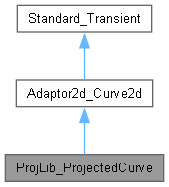
Compute the 2d-curve. Try to solve the particular case if possible. Otherwise, an approximation is done. For approximation some parameters are used, including required tolerance of approximation. Tolerance is maximal possible value of 3d deviation of 3d projection of projected curve from "exact" 3d projection. Since algorithm searches 2d curve on surface, required 2d tolerance is computed from 3d tolerance with help of U,V resolutions of surface. 3d and 2d tolerances have sense only for curves on surface, it defines precision of projecting and approximation and have nothing to do with distance between the projected curve and the surface. More...
#include <ProjLib_ProjectedCurve.hxx>
Public Member Functions | |
| ProjLib_ProjectedCurve () | |
| Empty constructor, it only sets some initial values for class fields. | |
| ProjLib_ProjectedCurve (const occ::handle< Adaptor3d_Surface > &S) | |
| Constructor with initialisation field mySurface. | |
| ProjLib_ProjectedCurve (const occ::handle< Adaptor3d_Surface > &S, const occ::handle< Adaptor3d_Curve > &C) | |
| Constructor, which performs projecting. If projecting uses approximation, default parameters are used, in particular, 3d tolerance of approximation is Precision::Confusion() | |
| ProjLib_ProjectedCurve (const occ::handle< Adaptor3d_Surface > &S, const occ::handle< Adaptor3d_Curve > &C, const double Tol) | |
| Constructor, which performs projecting. If projecting uses approximation, 3d tolerance is Tol, default parameters are used,. | |
| occ::handle< Adaptor2d_Curve2d > | ShallowCopy () const override |
| Shallow copy of adaptor. | |
| void | Load (const double Tolerance) |
| Changes the tolerance used to project the curve on the surface. | |
| void | Load (const occ::handle< Adaptor3d_Surface > &S) |
| Changes the Surface. | |
| void | Perform (const occ::handle< Adaptor3d_Curve > &C) |
| Performs projecting for given curve. If projecting uses approximation, approximation parameters can be set before by corresponding methods SetDegree(...), SetMaxSegmets(...), SetBndPnt(...), SetMaxDist(...) | |
| void | SetDegree (const int theDegMin, const int theDegMax) |
| Set min and max possible degree of result BSpline curve2d, which is got by approximation. If theDegMin/Max < 0, algorithm uses values that are chosen depending of types curve 3d and surface. | |
| void | SetMaxSegments (const int theMaxSegments) |
| Set the parameter, which defines maximal value of parametric intervals the projected curve can be cut for approximation. If theMaxSegments < 0, algorithm uses default value = 1000. | |
| void | SetBndPnt (const AppParCurves_Constraint theBndPnt) |
| Set the parameter, which defines type of boundary condition between segments during approximation. It can be AppParCurves_PassPoint or AppParCurves_TangencyPoint. Default value is AppParCurves_TangencyPoint;. | |
| void | SetMaxDist (const double theMaxDist) |
| Set the parameter, which degines maximal possible distance between projected curve and surface. It uses only for projecting on not analytical surfaces. If theMaxDist < 0, algorithm uses default value 100.*Tolerance. If real distance between curve and surface more then theMaxDist, algorithm stops working. | |
| const occ::handle< Adaptor3d_Surface > & | GetSurface () const |
| const occ::handle< Adaptor3d_Curve > & | GetCurve () const |
| double | GetTolerance () const |
| returns the tolerance reached if an approximation is Done. | |
| double | FirstParameter () const override |
| double | LastParameter () const override |
| GeomAbs_Shape | Continuity () const override |
| int | NbIntervals (const GeomAbs_Shape S) const override |
| If necessary, breaks the curve in intervals of continuity | |
| void | Intervals (NCollection_Array1< double > &T, const GeomAbs_Shape S) const override |
| Stores in <T> the parameters bounding the intervals of continuity | |
| occ::handle< Adaptor2d_Curve2d > | Trim (const double First, const double Last, const double Tol) const override |
| Returns a curve equivalent of <me> between parameters <First> and <Last>. <Tol> is used to test for 3d points confusion. If <First> >= <Last> | |
| bool | IsClosed () const override |
| bool | IsPeriodic () const override |
| double | Period () const override |
| gp_Pnt2d | Value (const double U) const override |
| Computes the point of parameter U on the curve. | |
| void | D0 (const double U, gp_Pnt2d &P) const override |
| Computes the point of parameter U on the curve. | |
| void | D1 (const double U, gp_Pnt2d &P, gp_Vec2d &V) const override |
| Computes the point of parameter U on the curve with its first derivative. Raised if the continuity of the current interval is not C1. | |
| void | D2 (const double U, gp_Pnt2d &P, gp_Vec2d &V1, gp_Vec2d &V2) const override |
| Returns the point P of parameter U, the first and second derivatives V1 and V2. Raised if the continuity of the current interval is not C2. | |
| void | D3 (const double U, gp_Pnt2d &P, gp_Vec2d &V1, gp_Vec2d &V2, gp_Vec2d &V3) const override |
| Returns the point P of parameter U, the first, the second and the third derivative. Raised if the continuity of the current interval is not C3. | |
| gp_Vec2d | DN (const double U, const int N) const override |
| The returned vector gives the value of the derivative for the order of derivation N. Raised if the continuity of the current interval is not CN. Raised if N < 1. | |
| double | Resolution (const double R3d) const override |
| Returns the parametric resolution corresponding to the real space resolution <R3d>. | |
| GeomAbs_CurveType | GetType () const override |
| Returns the type of the curve in the current interval: Line, Circle, Ellipse, Hyperbola, Parabola, BezierCurve, BSplineCurve, OtherCurve. | |
| gp_Lin2d | Line () const override |
| gp_Circ2d | Circle () const override |
| gp_Elips2d | Ellipse () const override |
| gp_Hypr2d | Hyperbola () const override |
| gp_Parab2d | Parabola () const override |
| int | Degree () const override |
| bool | IsRational () const override |
| int | NbPoles () const override |
| int | NbKnots () const override |
| occ::handle< Geom2d_BezierCurve > | Bezier () const override |
| Warning! This will NOT make a copy of the Bezier Curve If you want to modify the Curve please make a copy yourself. Also it will NOT trim the surface to myFirst/Last. | |
| occ::handle< Geom2d_BSplineCurve > | BSpline () const override |
| Warning! This will NOT make a copy of the BSpline Curve If you want to modify the Curve please make a copy yourself. Also it will NOT trim the surface to myFirst/Last. | |
 Public Member Functions inherited from Adaptor2d_Curve2d Public Member Functions inherited from Adaptor2d_Curve2d | |
| virtual int | NbSamples () const |
| virtual gp_Pnt2d | EvalD0 (const double theU) const |
| Computes the point of parameter U on the curve. Raises an exception on failure. | |
| virtual Geom2d_Curve::ResD1 | EvalD1 (const double theU) const |
| Computes the point and first derivative at parameter U. Raises an exception on failure. | |
| virtual Geom2d_Curve::ResD2 | EvalD2 (const double theU) const |
| Computes the point and first two derivatives at parameter U. Raises an exception on failure. | |
| virtual Geom2d_Curve::ResD3 | EvalD3 (const double theU) const |
| Computes the point and first three derivatives at parameter U. Raises an exception on failure. | |
| virtual gp_Vec2d | EvalDN (const double theU, const int theN) const |
| Computes the Nth derivative at parameter U. Raises an exception on failure. | |
| ~Adaptor2d_Curve2d () override | |
| Public Member Functions inherited from Standard_Transient | |
| Standard_Transient () | |
| Empty constructor. | |
| Standard_Transient (const Standard_Transient &) | |
| Copy constructor – does nothing. | |
| Standard_Transient & | operator= (const Standard_Transient &) |
| Assignment operator, needed to avoid copying reference counter. | |
| virtual | ~Standard_Transient ()=default |
| Destructor must be virtual. | |
| virtual const opencascade::handle< Standard_Type > & | DynamicType () const |
| Returns a type descriptor about this object. | |
| bool | IsInstance (const opencascade::handle< Standard_Type > &theType) const |
| Returns a true value if this is an instance of Type. | |
| bool | IsInstance (const char *const theTypeName) const |
| Returns a true value if this is an instance of TypeName. | |
| bool | IsKind (const opencascade::handle< Standard_Type > &theType) const |
| Returns true if this is an instance of Type or an instance of any class that inherits from Type. Note that multiple inheritance is not supported by OCCT RTTI mechanism. | |
| bool | IsKind (const char *const theTypeName) const |
| Returns true if this is an instance of TypeName or an instance of any class that inherits from TypeName. Note that multiple inheritance is not supported by OCCT RTTI mechanism. | |
| Standard_Transient * | This () const |
| Returns non-const pointer to this object (like const_cast). For protection against creating handle to objects allocated in stack or call from constructor, it will raise exception Standard_ProgramError if reference counter is zero. | |
| int | GetRefCount () const noexcept |
| Get the reference counter of this object. | |
| void | IncrementRefCounter () noexcept |
| Increments the reference counter of this object. Uses relaxed memory ordering since incrementing only requires atomicity, not synchronization with other memory operations. | |
| int | DecrementRefCounter () noexcept |
| Decrements the reference counter of this object; returns the decremented value. Uses release ordering for the decrement to ensure all writes to the object are visible before the count reaches zero. An acquire fence is added only when the count reaches zero, ensuring proper synchronization before deletion. This is more efficient than using acq_rel for every decrement. | |
| virtual void | Delete () const |
| Memory deallocator for transient classes. | |
Additional Inherited Members | |
| Public Types inherited from Standard_Transient | |
| typedef void | base_type |
| Returns a type descriptor about this object. | |
| Static Public Member Functions inherited from Standard_Transient | |
| static constexpr const char * | get_type_name () |
| Returns a type descriptor about this object. | |
| static const opencascade::handle< Standard_Type > & | get_type_descriptor () |
| Returns type descriptor of Standard_Transient class. | |
Compute the 2d-curve. Try to solve the particular case if possible. Otherwise, an approximation is done. For approximation some parameters are used, including required tolerance of approximation. Tolerance is maximal possible value of 3d deviation of 3d projection of projected curve from "exact" 3d projection. Since algorithm searches 2d curve on surface, required 2d tolerance is computed from 3d tolerance with help of U,V resolutions of surface. 3d and 2d tolerances have sense only for curves on surface, it defines precision of projecting and approximation and have nothing to do with distance between the projected curve and the surface.
| ProjLib_ProjectedCurve::ProjLib_ProjectedCurve | ( | ) |
Empty constructor, it only sets some initial values for class fields.
| ProjLib_ProjectedCurve::ProjLib_ProjectedCurve | ( | const occ::handle< Adaptor3d_Surface > & | S | ) |
Constructor with initialisation field mySurface.
| ProjLib_ProjectedCurve::ProjLib_ProjectedCurve | ( | const occ::handle< Adaptor3d_Surface > & | S, |
| const occ::handle< Adaptor3d_Curve > & | C ) |
Constructor, which performs projecting. If projecting uses approximation, default parameters are used, in particular, 3d tolerance of approximation is Precision::Confusion()
| ProjLib_ProjectedCurve::ProjLib_ProjectedCurve | ( | const occ::handle< Adaptor3d_Surface > & | S, |
| const occ::handle< Adaptor3d_Curve > & | C, | ||
| const double | Tol ) |
Constructor, which performs projecting. If projecting uses approximation, 3d tolerance is Tol, default parameters are used,.
|
overridevirtual |
Warning! This will NOT make a copy of the Bezier Curve If you want to modify the Curve please make a copy yourself. Also it will NOT trim the surface to myFirst/Last.
Reimplemented from Adaptor2d_Curve2d.
|
overridevirtual |
Warning! This will NOT make a copy of the BSpline Curve If you want to modify the Curve please make a copy yourself. Also it will NOT trim the surface to myFirst/Last.
Reimplemented from Adaptor2d_Curve2d.
|
overridevirtual |
Reimplemented from Adaptor2d_Curve2d.
|
overridevirtual |
Reimplemented from Adaptor2d_Curve2d.
Computes the point of parameter U on the curve.
Reimplemented from Adaptor2d_Curve2d.
|
overridevirtual |
Computes the point of parameter U on the curve with its first derivative. Raised if the continuity of the current interval is not C1.
Reimplemented from Adaptor2d_Curve2d.
|
overridevirtual |
Returns the point P of parameter U, the first and second derivatives V1 and V2. Raised if the continuity of the current interval is not C2.
Reimplemented from Adaptor2d_Curve2d.
|
overridevirtual |
Returns the point P of parameter U, the first, the second and the third derivative. Raised if the continuity of the current interval is not C3.
Reimplemented from Adaptor2d_Curve2d.
|
overridevirtual |
Reimplemented from Adaptor2d_Curve2d.
The returned vector gives the value of the derivative for the order of derivation N. Raised if the continuity of the current interval is not CN. Raised if N < 1.
Reimplemented from Adaptor2d_Curve2d.
|
overridevirtual |
Reimplemented from Adaptor2d_Curve2d.
|
overridevirtual |
Reimplemented from Adaptor2d_Curve2d.
| const occ::handle< Adaptor3d_Curve > & ProjLib_ProjectedCurve::GetCurve | ( | ) | const |
| const occ::handle< Adaptor3d_Surface > & ProjLib_ProjectedCurve::GetSurface | ( | ) | const |
| double ProjLib_ProjectedCurve::GetTolerance | ( | ) | const |
returns the tolerance reached if an approximation is Done.
|
overridevirtual |
Returns the type of the curve in the current interval: Line, Circle, Ellipse, Hyperbola, Parabola, BezierCurve, BSplineCurve, OtherCurve.
Reimplemented from Adaptor2d_Curve2d.
|
overridevirtual |
Reimplemented from Adaptor2d_Curve2d.
|
overridevirtual |
Stores in <T> the parameters bounding the intervals of continuity .
The array must provide enough room to accommodate for the parameters. i.e. T.Length() > NbIntervals()
Reimplemented from Adaptor2d_Curve2d.
|
overridevirtual |
Reimplemented from Adaptor2d_Curve2d.
|
overridevirtual |
Reimplemented from Adaptor2d_Curve2d.
|
overridevirtual |
Reimplemented from Adaptor2d_Curve2d.
|
overridevirtual |
Reimplemented from Adaptor2d_Curve2d.
|
overridevirtual |
Reimplemented from Adaptor2d_Curve2d.
Changes the tolerance used to project the curve on the surface.
| void ProjLib_ProjectedCurve::Load | ( | const occ::handle< Adaptor3d_Surface > & | S | ) |
Changes the Surface.
|
overridevirtual |
If necessary, breaks the curve in intervals of continuity . And returns the number of intervals.
Reimplemented from Adaptor2d_Curve2d.
|
overridevirtual |
Reimplemented from Adaptor2d_Curve2d.
|
overridevirtual |
Reimplemented from Adaptor2d_Curve2d.
|
overridevirtual |
Reimplemented from Adaptor2d_Curve2d.
| void ProjLib_ProjectedCurve::Perform | ( | const occ::handle< Adaptor3d_Curve > & | C | ) |
Performs projecting for given curve. If projecting uses approximation, approximation parameters can be set before by corresponding methods SetDegree(...), SetMaxSegmets(...), SetBndPnt(...), SetMaxDist(...)
|
overridevirtual |
Reimplemented from Adaptor2d_Curve2d.
Returns the parametric resolution corresponding to the real space resolution <R3d>.
Reimplemented from Adaptor2d_Curve2d.
| void ProjLib_ProjectedCurve::SetBndPnt | ( | const AppParCurves_Constraint | theBndPnt | ) |
Set the parameter, which defines type of boundary condition between segments during approximation. It can be AppParCurves_PassPoint or AppParCurves_TangencyPoint. Default value is AppParCurves_TangencyPoint;.
Set min and max possible degree of result BSpline curve2d, which is got by approximation. If theDegMin/Max < 0, algorithm uses values that are chosen depending of types curve 3d and surface.
Set the parameter, which degines maximal possible distance between projected curve and surface. It uses only for projecting on not analytical surfaces. If theMaxDist < 0, algorithm uses default value 100.*Tolerance. If real distance between curve and surface more then theMaxDist, algorithm stops working.
Set the parameter, which defines maximal value of parametric intervals the projected curve can be cut for approximation. If theMaxSegments < 0, algorithm uses default value = 1000.
|
overridevirtual |
Shallow copy of adaptor.
Reimplemented from Adaptor2d_Curve2d.
|
overridevirtual |
Returns a curve equivalent of <me> between parameters <First> and <Last>. <Tol> is used to test for 3d points confusion. If <First> >= <Last>
Reimplemented from Adaptor2d_Curve2d.
Computes the point of parameter U on the curve.
Reimplemented from Adaptor2d_Curve2d.
 1.10.0