 |
Open CASCADE Technology Reference Manual 8.0.0
|
Loading...
Searching...
No Matches
|
Open CASCADE Technology Reference Manual 8.0.0
|
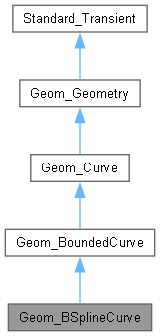
Definition of the B_spline curve. A B-spline curve can be Uniform or non-uniform Rational or non-rational Periodic or non-periodic. More...
#include <Geom_BSplineCurve.hxx>
Public Member Functions | |
| Geom_BSplineCurve (const NCollection_Array1< gp_Pnt > &Poles, const NCollection_Array1< double > &Knots, const NCollection_Array1< int > &Multiplicities, const int Degree, const bool Periodic=false) | |
| Creates a non-rational B_spline curve on the basis <Knots, Multiplicities> of degree <Degree>. | |
| Geom_BSplineCurve (const NCollection_Array1< gp_Pnt > &Poles, const NCollection_Array1< double > &Weights, const NCollection_Array1< double > &Knots, const NCollection_Array1< int > &Multiplicities, const int Degree, const bool Periodic=false, const bool CheckRational=true) | |
| Creates a rational B_spline curve on the basis <Knots, Multiplicities> of degree <Degree>. Raises ConstructionError subject to the following conditions 0 < Degree <= MaxDegree. | |
| Geom_BSplineCurve (const Geom_BSplineCurve &theOther) | |
| Copy constructor for optimized copying without validation. | |
| bool | HasEvalRepresentation () const |
| Returns true if an evaluation representation is attached. | |
| const occ::handle< GeomEval_RepCurveDesc::Base > & | EvalRepresentation () const |
| Returns the current evaluation representation descriptor (may be null). | |
| void | SetEvalRepresentation (const occ::handle< GeomEval_RepCurveDesc::Base > &theDesc) |
| Sets a new evaluation representation. Validates descriptor data and ensures no circular references. | |
| void | ClearEvalRepresentation () |
| Removes the evaluation representation. | |
| void | IncreaseDegree (const int Degree) |
| Increases the degree of this BSpline curve to Degree. As a result, the poles, weights and multiplicities tables are modified; the knots table is not changed. Nothing is done if Degree is less than or equal to the current degree. Exceptions Standard_ConstructionError if Degree is greater than Geom_BSplineCurve::MaxDegree(). | |
| void | IncreaseMultiplicity (const int Index, const int M) |
| Increases the multiplicity of the knot <Index> to <M>. | |
| void | IncreaseMultiplicity (const int I1, const int I2, const int M) |
| Increases the multiplicities of the knots in [I1,I2] to <M>. | |
| void | IncrementMultiplicity (const int I1, const int I2, const int M) |
| Increment the multiplicities of the knots in [I1,I2] by <M>. | |
| void | InsertKnot (const double U, const int M=1, const double ParametricTolerance=0.0, const bool Add=true) |
| Inserts a knot value in the sequence of knots. If is an existing knot the multiplicity is increased by <M>. | |
| void | InsertKnots (const NCollection_Array1< double > &Knots, const NCollection_Array1< int > &Mults, const double ParametricTolerance=0.0, const bool Add=false) |
| Inserts a set of knots values in the sequence of knots. | |
| bool | RemoveKnot (const int Index, const int M, const double Tolerance) |
| Reduces the multiplicity of the knot of index Index to M. If M is equal to 0, the knot is removed. With a modification of this type, the array of poles is also modified. Two different algorithms are systematically used to compute the new poles of the curve. If, for each pole, the distance between the pole calculated using the first algorithm and the same pole calculated using the second algorithm, is less than Tolerance, this ensures that the curve is not modified by more than Tolerance. Under these conditions, true is returned; otherwise, false is returned. A low tolerance is used to prevent modification of the curve. A high tolerance is used to "smooth" the curve. Exceptions Standard_OutOfRange if Index is outside the bounds of the knots table. pole insertion and pole removing this operation is limited to the Uniform or QuasiUniform BSplineCurve. The knot values are modified. If the BSpline is NonUniform or Piecewise Bezier an exception Construction error is raised. | |
| void | Reverse () final |
| Changes the direction of parametrization of <me>. The Knot sequence is modified, the FirstParameter and the LastParameter are not modified. The StartPoint of the initial curve becomes the EndPoint of the reversed curve and the EndPoint of the initial curve becomes the StartPoint of the reversed curve. | |
| double | ReversedParameter (const double U) const final |
| Returns the parameter on the reversed curve for the point of parameter U on <me>. | |
| void | Segment (const double U1, const double U2, const double theTolerance=Precision::PConfusion()) |
| Modifies this BSpline curve by segmenting it between U1 and U2. Either of these values can be outside the bounds of the curve, but U2 must be greater than U1. All data structure tables of this BSpline curve are modified, but the knots located between U1 and U2 are retained. The degree of the curve is not modified. | |
| void | SetKnot (const int Index, const double K) |
| Modifies this BSpline curve by assigning the value K to the knot of index Index in the knots table. This is a relatively local modification because K must be such that: Knots(Index - 1) < K < Knots(Index + 1) The second syntax allows you also to increase the multiplicity of the knot to M (but it is not possible to decrease the multiplicity of the knot with this function). Standard_ConstructionError if: | |
| void | SetKnots (const NCollection_Array1< double > &K) |
| Modifies this BSpline curve by assigning the array K to its knots table. The multiplicity of the knots is not modified. Exceptions Standard_ConstructionError if the values in the array K are not in ascending order. Standard_OutOfRange if the bounds of the array K are not respectively 1 and the number of knots of this BSpline curve. | |
| void | SetKnot (const int Index, const double K, const int M) |
| Changes the knot of range Index with its multiplicity. You can increase the multiplicity of a knot but it is not allowed to decrease the multiplicity of an existing knot. | |
| void | PeriodicNormalization (double &U) const |
| returns the parameter normalized within the period if the curve is periodic : otherwise does not do anything | |
| void | SetPeriodic () |
| Changes this BSpline curve into a periodic curve. To become periodic, the curve must first be closed. Next, the knot sequence must be periodic. For this, FirstUKnotIndex and LastUKnotIndex are used to compute I1 and I2, the indexes in the knots array of the knots corresponding to the first and last parameters of this BSpline curve. The period is therefore: Knots(I2) - Knots(I1). Consequently, the knots and poles tables are modified. Exceptions Standard_ConstructionError if this BSpline curve is not closed. | |
| void | SetOrigin (const int Index) |
| Assigns the knot of index Index in the knots table as the origin of this periodic BSpline curve. As a consequence, the knots and poles tables are modified. Exceptions Standard_NoSuchObject if this curve is not periodic. Standard_DomainError if Index is outside the bounds of the knots table. | |
| void | SetOrigin (const double U, const double Tol) |
| Set the origin of a periodic curve at Knot U. If U is not a knot of the BSpline a new knot is inserted. KnotVector and poles are modified. Raised if the curve is not periodic. | |
| void | SetNotPeriodic () |
| Changes this BSpline curve into a non-periodic curve. If this curve is already non-periodic, it is not modified. Note: the poles and knots tables are modified. Warning If this curve is periodic, as the multiplicity of the first and last knots is not modified, and is not equal to Degree + 1, where Degree is the degree of this BSpline curve, the start and end points of the curve are not its first and last poles. | |
| void | SetPole (const int Index, const gp_Pnt &P) |
| Modifies this BSpline curve by assigning P to the pole of index Index in the poles table. Exceptions Standard_OutOfRange if Index is outside the bounds of the poles table. Standard_ConstructionError if Weight is negative or null. | |
| void | SetPole (const int Index, const gp_Pnt &P, const double Weight) |
| Modifies this BSpline curve by assigning P to the pole of index Index in the poles table. This syntax also allows you to modify the weight of the modified pole, which becomes Weight. In this case, if this BSpline curve is non-rational, it can become rational and vice versa. Exceptions Standard_OutOfRange if Index is outside the bounds of the poles table. Standard_ConstructionError if Weight is negative or null. | |
| void | SetWeight (const int Index, const double Weight) |
| Changes the weight for the pole of range Index. If the curve was non rational it can become rational. If the curve was rational it can become non rational. | |
| void | MovePoint (const double U, const gp_Pnt &P, const int Index1, const int Index2, int &FirstModifiedPole, int &LastModifiedPole) |
| Moves the point of parameter U of this BSpline curve to P. Index1 and Index2 are the indexes in the table of poles of this BSpline curve of the first and last poles designated to be moved. FirstModifiedPole and LastModifiedPole are the indexes of the first and last poles which are effectively modified. In the event of incompatibility between Index1, Index2 and the value U: | |
| void | MovePointAndTangent (const double U, const gp_Pnt &P, const gp_Vec &Tangent, const double Tolerance, const int StartingCondition, const int EndingCondition, int &ErrorStatus) |
| Move a point with parameter U to P. and makes it tangent at U be Tangent. StartingCondition = -1 means first can move EndingCondition = -1 means last point can move StartingCondition = 0 means the first point cannot move EndingCondition = 0 means the last point cannot move StartingCondition = 1 means the first point and tangent cannot move EndingCondition = 1 means the last point and tangent cannot move and so forth ErrorStatus != 0 means that there are not enough degree of freedom with the constrain to deform the curve accordingly. | |
| bool | IsCN (const int N) const final |
| Returns the continuity of the curve, the curve is at least C0. Raised if N < 0. | |
| bool | IsG1 (const double theTf, const double theTl, const double theAngTol) const |
| Check if curve has at least G1 continuity in interval [theTf, theTl] Returns true if IsCN(1) or angle between "left" and "right" first derivatives at knots with C0 continuity is less then theAngTol only knots in interval [theTf, theTl] is checked. | |
| bool | IsClosed () const final |
| Returns true if the distance between the first point and the last point of the curve is lower or equal to Resolution from package gp. Warnings : The first and the last point can be different from the first pole and the last pole of the curve. | |
| bool | IsPeriodic () const final |
| Returns True if the curve is periodic. | |
| bool | IsRational () const |
| Returns True if the weights are not identical. The tolerance criterion is Epsilon of the class Real. | |
| GeomAbs_Shape | Continuity () const final |
| Returns the global continuity of the curve : C0 : only geometric continuity, C1 : continuity of the first derivative all along the Curve, C2 : continuity of the second derivative all along the Curve, C3 : continuity of the third derivative all along the Curve, CN : the order of continuity is infinite. For a B-spline curve of degree d if a knot Ui has a multiplicity p the B-spline curve is only Cd-p continuous at Ui. So the global continuity of the curve can't be greater than Cd-p where p is the maximum multiplicity of the interior Knots. In the interior of a knot span the curve is infinitely continuously differentiable. | |
| int | Degree () const |
| Returns the degree of this BSpline curve. The degree of a Geom_BSplineCurve curve cannot be greater than Geom_BSplineCurve::MaxDegree(). Computation of value and derivatives. | |
| gp_Pnt | EvalD0 (const double U) const final |
| Returns the point of parameter U. | |
| Geom_Curve::ResD1 | EvalD1 (const double U) const final |
| Raised if the continuity of the curve is not C1. | |
| Geom_Curve::ResD2 | EvalD2 (const double U) const final |
| Raised if the continuity of the curve is not C2. | |
| Geom_Curve::ResD3 | EvalD3 (const double U) const final |
| Raised if the continuity of the curve is not C3. | |
| gp_Vec | EvalDN (const double U, const int N) const final |
| For the point of parameter U of this BSpline curve, computes the vector corresponding to the Nth derivative. Warning On a point where the continuity of the curve is not the one requested, this function impacts the part defined by the parameter with a value greater than U, i.e. the part of the curve to the "right" of the singularity. Exceptions Standard_RangeError if N is less than 1. | |
| gp_Pnt | LocalValue (const double U, const int FromK1, const int ToK2) const |
| Raised if FromK1 = ToK2. | |
| void | LocalD0 (const double U, const int FromK1, const int ToK2, gp_Pnt &P) const |
| Raised if FromK1 = ToK2. | |
| void | LocalD1 (const double U, const int FromK1, const int ToK2, gp_Pnt &P, gp_Vec &V1) const |
| Raised if the local continuity of the curve is not C1 between the knot K1 and the knot K2. Raised if FromK1 = ToK2. | |
| void | LocalD2 (const double U, const int FromK1, const int ToK2, gp_Pnt &P, gp_Vec &V1, gp_Vec &V2) const |
| Raised if the local continuity of the curve is not C2 between the knot K1 and the knot K2. Raised if FromK1 = ToK2. | |
| void | LocalD3 (const double U, const int FromK1, const int ToK2, gp_Pnt &P, gp_Vec &V1, gp_Vec &V2, gp_Vec &V3) const |
| Raised if the local continuity of the curve is not C3 between the knot K1 and the knot K2. Raised if FromK1 = ToK2. | |
| gp_Vec | LocalDN (const double U, const int FromK1, const int ToK2, const int N) const |
| Raised if the local continuity of the curve is not CN between the knot K1 and the knot K2. Raised if FromK1 = ToK2. Raised if N < 1. | |
| gp_Pnt | EndPoint () const final |
| Returns the last point of the curve. Warnings : The last point of the curve is different from the last pole of the curve if the multiplicity of the last knot is lower than Degree. | |
| int | FirstUKnotIndex () const |
| Returns the index in the knot array of the knot corresponding to the first or last parameter of this BSpline curve. For a BSpline curve, the first (or last) parameter (which gives the start (or end) point of the curve) is a knot value. However, if the multiplicity of the first (or last) knot is less than Degree + 1, where Degree is the degree of the curve, it is not the first (or last) knot of the curve. | |
| double | FirstParameter () const final |
| Returns the value of the first parameter of this BSpline curve. This is a knot value. The first parameter is the one of the start point of the BSpline curve. | |
| double | Knot (const int Index) const |
| Returns the knot of range Index. When there is a knot with a multiplicity greater than 1 the knot is not repeated. The method Multiplicity can be used to get the multiplicity of the Knot. Raised if Index < 1 or Index > NbKnots. | |
| void | Knots (NCollection_Array1< double > &K) const |
| returns the knot values of the B-spline curve; Warning A knot with a multiplicity greater than 1 is not repeated in the knot table. The Multiplicity function can be used to obtain the multiplicity of each knot. | |
| const NCollection_Array1< double > & | Knots () const |
| returns the knot values of the B-spline curve; Warning A knot with a multiplicity greater than 1 is not repeated in the knot table. The Multiplicity function can be used to obtain the multiplicity of each knot. | |
| void | KnotSequence (NCollection_Array1< double > &K) const |
| Returns K, the knots sequence of this BSpline curve. In this sequence, knots with a multiplicity greater than 1 are repeated. In the case of a non-periodic curve the length of the sequence must be equal to the sum of the NbKnots multiplicities of the knots of the curve (where NbKnots is the number of knots of this BSpline curve). This sum is also equal to : NbPoles + Degree + 1 where NbPoles is the number of poles and Degree the degree of this BSpline curve. In the case of a periodic curve, if there are k periodic knots, the period is Knot(k+1) - Knot(1). The initial sequence is built by writing knots 1 to k+1, which are repeated according to their corresponding multiplicities. If Degree is the degree of the curve, the degree of continuity of the curve at the knot of index 1 (or k+1) is equal to c = Degree + 1 - Mult(1). c knots are then inserted at the beginning and end of the initial sequence: | |
| const NCollection_Array1< double > & | KnotSequence () const |
| returns the knots of the B-spline curve. Knots with multiplicit greater than 1 are repeated | |
| GeomAbs_BSplKnotDistribution | KnotDistribution () const |
| Returns NonUniform or Uniform or QuasiUniform or PiecewiseBezier. If all the knots differ by a positive constant from the preceding knot the BSpline Curve can be : | |
| int | LastUKnotIndex () const |
| For a BSpline curve the last parameter (which gives the end point of the curve) is a knot value but if the multiplicity of the last knot index is lower than Degree + 1 it is not the last knot of the curve. This method computes the index of the knot corresponding to the last parameter. | |
| double | LastParameter () const final |
| Computes the parametric value of the end point of the curve. It is a knot value. | |
| void | LocateU (const double U, const double ParametricTolerance, int &I1, int &I2, const bool WithKnotRepetition=false) const |
| Locates the parametric value U in the sequence of knots. If "WithKnotRepetition" is True we consider the knot's representation with repetition of multiple knot value, otherwise we consider the knot's representation with no repetition of multiple knot values. Knots (I1) <= U <= Knots (I2) . if I1 = I2 U is a knot value (the tolerance criterion ParametricTolerance is used). . if I1 < 1 => U < Knots (1) - std::abs(ParametricTolerance) . if I2 > NbKnots => U > Knots (NbKnots) + std::abs(ParametricTolerance) | |
| int | Multiplicity (const int Index) const |
| Returns the multiplicity of the knots of range Index. Raised if Index < 1 or Index > NbKnots. | |
| void | Multiplicities (NCollection_Array1< int > &M) const |
| Returns the multiplicity of the knots of the curve. | |
| const NCollection_Array1< int > & | Multiplicities () const |
| returns the multiplicity of the knots of the curve. | |
| int | NbKnots () const |
| Returns the number of knots. This method returns the number of knot without repetition of multiple knots. | |
| int | NbPoles () const |
| Returns the number of poles. | |
| const gp_Pnt & | Pole (const int Index) const |
| Returns the pole of range Index. Raised if Index < 1 or Index > NbPoles. | |
| void | Poles (NCollection_Array1< gp_Pnt > &P) const |
| Returns the poles of the B-spline curve;. | |
| const NCollection_Array1< gp_Pnt > & | Poles () const |
| Returns the poles of the B-spline curve;. | |
| gp_Pnt | StartPoint () const final |
| Returns the start point of the curve. Warnings : This point is different from the first pole of the curve if the multiplicity of the first knot is lower than Degree. | |
| double | Weight (const int Index) const |
| Returns the weight of the pole of range Index . Raised if Index < 1 or Index > NbPoles. | |
| void | Weights (NCollection_Array1< double > &W) const |
| Returns the weights of the B-spline curve;. | |
| const NCollection_Array1< double > * | Weights () const |
| Returns the weights of the B-spline curve;. | |
| const NCollection_Array1< double > & | WeightsArray () const |
| Returns a const reference to the weights array. For rational curves: the internal owning weights array. For non-rational curves: a non-owning view of unit weights from BSplCLib. The array is always sized to match NbPoles(). | |
| void | Transform (const gp_Trsf &T) final |
| Applies the transformation T to this BSpline curve. | |
| void | Resolution (const double Tolerance3D, double &UTolerance) |
| Computes for this BSpline curve the parametric tolerance UTolerance for a given 3D tolerance Tolerance3D. If f(t) is the equation of this BSpline curve, UTolerance ensures that: | t1 - t0| < Utolerance ===> |f(t1) - f(t0)| < Tolerance3D. | |
| occ::handle< Geom_Geometry > | Copy () const final |
| Creates a new object which is a copy of this BSpline curve. | |
| bool | IsEqual (const occ::handle< Geom_BSplineCurve > &theOther, const double thePreci) const |
| Compare two Bspline curve on identity;. | |
| void | DumpJson (Standard_OStream &theOStream, int theDepth=-1) const final |
| Dumps the content of me into the stream. | |
 Public Member Functions inherited from Geom_Curve Public Member Functions inherited from Geom_Curve | |
| virtual double | TransformedParameter (const double U, const gp_Trsf &T) const |
| Returns the parameter on the transformed curve for the transform of the point of parameter U on <me>. | |
| virtual double | ParametricTransformation (const gp_Trsf &T) const |
| Returns a coefficient to compute the parameter on the transformed curve for the transform of the point on <me>. | |
| occ::handle< Geom_Curve > | Reversed () const |
| Returns a copy of <me> reversed. | |
| virtual double | Period () const |
| Returns the period of this curve. Exceptions Standard_NoSuchObject if this curve is not periodic. | |
| void | D0 (const double U, gp_Pnt &P) const |
| Returns in P the point of parameter U. | |
| void | D1 (const double U, gp_Pnt &P, gp_Vec &V1) const |
| Returns the point P of parameter U and the first derivative V1. | |
| void | D2 (const double U, gp_Pnt &P, gp_Vec &V1, gp_Vec &V2) const |
| Returns the point P of parameter U, the first and second derivatives V1 and V2. | |
| void | D3 (const double U, gp_Pnt &P, gp_Vec &V1, gp_Vec &V2, gp_Vec &V3) const |
| Returns the point P of parameter U, the first, the second and the third derivative. | |
| gp_Vec | DN (const double U, const int N) const |
| The returned vector gives the value of the derivative for the order of derivation N. | |
| gp_Pnt | Value (const double U) const |
| Computes the point of parameter U on <me>. | |
| void | DumpJson (Standard_OStream &theOStream, int theDepth=-1) const override |
| Dumps the content of me into the stream. | |
| Public Member Functions inherited from Geom_Geometry | |
| void | Mirror (const gp_Pnt &P) |
| Performs the symmetrical transformation of a Geometry with respect to the point P which is the center of the symmetry. | |
| void | Mirror (const gp_Ax1 &A1) |
| Performs the symmetrical transformation of a Geometry with respect to an axis placement which is the axis of the symmetry. | |
| void | Mirror (const gp_Ax2 &A2) |
| Performs the symmetrical transformation of a Geometry with respect to a plane. The axis placement A2 locates the plane of the symmetry : (Location, XDirection, YDirection). | |
| void | Rotate (const gp_Ax1 &A1, const double Ang) |
| Rotates a Geometry. A1 is the axis of the rotation. Ang is the angular value of the rotation in radians. | |
| void | Scale (const gp_Pnt &P, const double S) |
| Scales a Geometry. S is the scaling value. | |
| void | Translate (const gp_Vec &V) |
| Translates a Geometry. V is the vector of the translation. | |
| void | Translate (const gp_Pnt &P1, const gp_Pnt &P2) |
| Translates a Geometry from the point P1 to the point P2. | |
| occ::handle< Geom_Geometry > | Mirrored (const gp_Pnt &P) const |
| occ::handle< Geom_Geometry > | Mirrored (const gp_Ax1 &A1) const |
| occ::handle< Geom_Geometry > | Mirrored (const gp_Ax2 &A2) const |
| occ::handle< Geom_Geometry > | Rotated (const gp_Ax1 &A1, const double Ang) const |
| occ::handle< Geom_Geometry > | Scaled (const gp_Pnt &P, const double S) const |
| occ::handle< Geom_Geometry > | Transformed (const gp_Trsf &T) const |
| occ::handle< Geom_Geometry > | Translated (const gp_Vec &V) const |
| occ::handle< Geom_Geometry > | Translated (const gp_Pnt &P1, const gp_Pnt &P2) const |
| Public Member Functions inherited from Standard_Transient | |
| Standard_Transient () | |
| Empty constructor. | |
| Standard_Transient (const Standard_Transient &) | |
| Copy constructor – does nothing. | |
| Standard_Transient & | operator= (const Standard_Transient &) |
| Assignment operator, needed to avoid copying reference counter. | |
| virtual | ~Standard_Transient ()=default |
| Destructor must be virtual. | |
| virtual const opencascade::handle< Standard_Type > & | DynamicType () const |
| Returns a type descriptor about this object. | |
| bool | IsInstance (const opencascade::handle< Standard_Type > &theType) const |
| Returns a true value if this is an instance of Type. | |
| bool | IsInstance (const char *const theTypeName) const |
| Returns a true value if this is an instance of TypeName. | |
| bool | IsKind (const opencascade::handle< Standard_Type > &theType) const |
| Returns true if this is an instance of Type or an instance of any class that inherits from Type. Note that multiple inheritance is not supported by OCCT RTTI mechanism. | |
| bool | IsKind (const char *const theTypeName) const |
| Returns true if this is an instance of TypeName or an instance of any class that inherits from TypeName. Note that multiple inheritance is not supported by OCCT RTTI mechanism. | |
| Standard_Transient * | This () const |
| Returns non-const pointer to this object (like const_cast). For protection against creating handle to objects allocated in stack or call from constructor, it will raise exception Standard_ProgramError if reference counter is zero. | |
| int | GetRefCount () const noexcept |
| Get the reference counter of this object. | |
| void | IncrementRefCounter () noexcept |
| Increments the reference counter of this object. Uses relaxed memory ordering since incrementing only requires atomicity, not synchronization with other memory operations. | |
| int | DecrementRefCounter () noexcept |
| Decrements the reference counter of this object; returns the decremented value. Uses release ordering for the decrement to ensure all writes to the object are visible before the count reaches zero. An acquire fence is added only when the count reaches zero, ensuring proper synchronization before deletion. This is more efficient than using acq_rel for every decrement. | |
| virtual void | Delete () const |
| Memory deallocator for transient classes. | |
Static Public Member Functions | |
| static int | MaxDegree () |
| Returns the value of the maximum degree of the normalized B-spline basis functions in this package. | |
| Static Public Member Functions inherited from Standard_Transient | |
| static constexpr const char * | get_type_name () |
| Returns a type descriptor about this object. | |
| static const opencascade::handle< Standard_Type > & | get_type_descriptor () |
| Returns type descriptor of Standard_Transient class. | |
Protected Member Functions | |
| void | updateKnots () |
| Recompute the flatknots, the knotsdistribution, the continuity. | |
Additional Inherited Members | |
| Public Types inherited from Standard_Transient | |
| typedef void | base_type |
| Returns a type descriptor about this object. | |
Definition of the B_spline curve. A B-spline curve can be Uniform or non-uniform Rational or non-rational Periodic or non-periodic.
a b-spline curve is defined by : its degree; the degree for a Geom_BSplineCurve is limited to a value (25) which is defined and controlled by the system. This value is returned by the function MaxDegree;
References : . A survey of curve and surface methods in CADG Wolfgang BOHM CAGD 1 (1984) . On de Boor-like algorithms and blossoming Wolfgang BOEHM cagd 5 (1988) . Blossoming and knot insertion algorithms for B-spline curves Ronald N. GOLDMAN . Modelisation des surfaces en CAO, Henri GIAUME Peugeot SA . Curves and Surfaces for Computer Aided Geometric Design, a practical guide Gerald Farin
| Geom_BSplineCurve::Geom_BSplineCurve | ( | const NCollection_Array1< gp_Pnt > & | Poles, |
| const NCollection_Array1< double > & | Knots, | ||
| const NCollection_Array1< int > & | Multiplicities, | ||
| const int | Degree, | ||
| const bool | Periodic = false ) |
Creates a non-rational B_spline curve on the basis <Knots, Multiplicities> of degree <Degree>.
| Geom_BSplineCurve::Geom_BSplineCurve | ( | const NCollection_Array1< gp_Pnt > & | Poles, |
| const NCollection_Array1< double > & | Weights, | ||
| const NCollection_Array1< double > & | Knots, | ||
| const NCollection_Array1< int > & | Multiplicities, | ||
| const int | Degree, | ||
| const bool | Periodic = false, | ||
| const bool | CheckRational = true ) |
Creates a rational B_spline curve on the basis <Knots, Multiplicities> of degree <Degree>. Raises ConstructionError subject to the following conditions 0 < Degree <= MaxDegree.
Weights.Length() == Poles.Length()
Knots.Length() == Mults.Length() >= 2
Knots(i) < Knots(i+1) (Knots are increasing)
1 <= Mults(i) <= Degree
On a non periodic curve the first and last multiplicities may be Degree+1 (this is even recommended if you want the curve to start and finish on the first and last pole).
On a periodic curve the first and the last multicities must be the same.
on non-periodic curves
Poles.Length() == Sum(Mults(i)) - Degree - 1 >= 2
on periodic curves
Poles.Length() == Sum(Mults(i)) except the first or last
| Geom_BSplineCurve::Geom_BSplineCurve | ( | const Geom_BSplineCurve & | theOther | ) |
Copy constructor for optimized copying without validation.
| [in] | theOther | the BSpline curve to copy from |
|
inline |
Removes the evaluation representation.
|
finalvirtual |
Returns the global continuity of the curve : C0 : only geometric continuity, C1 : continuity of the first derivative all along the Curve, C2 : continuity of the second derivative all along the Curve, C3 : continuity of the third derivative all along the Curve, CN : the order of continuity is infinite. For a B-spline curve of degree d if a knot Ui has a multiplicity p the B-spline curve is only Cd-p continuous at Ui. So the global continuity of the curve can't be greater than Cd-p where p is the maximum multiplicity of the interior Knots. In the interior of a knot span the curve is infinitely continuously differentiable.
Implements Geom_Curve.
|
finalvirtual |
Creates a new object which is a copy of this BSpline curve.
Implements Geom_Geometry.
| int Geom_BSplineCurve::Degree | ( | ) | const |
Returns the degree of this BSpline curve. The degree of a Geom_BSplineCurve curve cannot be greater than Geom_BSplineCurve::MaxDegree(). Computation of value and derivatives.
|
finalvirtual |
Dumps the content of me into the stream.
Reimplemented from Geom_BoundedCurve.
|
finalvirtual |
Returns the last point of the curve. Warnings : The last point of the curve is different from the last pole of the curve if the multiplicity of the last knot is lower than Degree.
Implements Geom_BoundedCurve.
Returns the point of parameter U.
Implements Geom_Curve.
|
finalvirtual |
Raised if the continuity of the curve is not C1.
Implements Geom_Curve.
|
finalvirtual |
Raised if the continuity of the curve is not C2.
Implements Geom_Curve.
|
finalvirtual |
Raised if the continuity of the curve is not C3.
Implements Geom_Curve.
For the point of parameter U of this BSpline curve, computes the vector corresponding to the Nth derivative. Warning On a point where the continuity of the curve is not the one requested, this function impacts the part defined by the parameter with a value greater than U, i.e. the part of the curve to the "right" of the singularity. Exceptions Standard_RangeError if N is less than 1.
The following functions compute the point of parameter U and the derivatives at this point on the B-spline curve arc defined between the knot FromK1 and the knot ToK2. U can be out of bounds [Knot (FromK1), Knot (ToK2)] but for the computation we only use the definition of the curve between these two knots. This method is useful to compute local derivative, if the order of continuity of the whole curve is not greater enough. Inside the parametric domain Knot (FromK1), Knot (ToK2) the evaluations are the same as if we consider the whole definition of the curve. Of course the evaluations are different outside this parametric domain.
Implements Geom_Curve.
|
inline |
Returns the current evaluation representation descriptor (may be null).
|
finalvirtual |
Returns the value of the first parameter of this BSpline curve. This is a knot value. The first parameter is the one of the start point of the BSpline curve.
Implements Geom_Curve.
| int Geom_BSplineCurve::FirstUKnotIndex | ( | ) | const |
Returns the index in the knot array of the knot corresponding to the first or last parameter of this BSpline curve. For a BSpline curve, the first (or last) parameter (which gives the start (or end) point of the curve) is a knot value. However, if the multiplicity of the first (or last) knot is less than Degree + 1, where Degree is the degree of the curve, it is not the first (or last) knot of the curve.
|
inline |
Returns true if an evaluation representation is attached.
Increases the degree of this BSpline curve to Degree. As a result, the poles, weights and multiplicities tables are modified; the knots table is not changed. Nothing is done if Degree is less than or equal to the current degree. Exceptions Standard_ConstructionError if Degree is greater than Geom_BSplineCurve::MaxDegree().
Increases the multiplicities of the knots in [I1,I2] to <M>.
For each knot if <M> is lower or equal to the current multiplicity nothing is done. If <M> is higher than the degree the degree is used. If <I1,I2> are not in [FirstUKnotIndex, LastUKnotIndex]
Increases the multiplicity of the knot <Index> to <M>.
If <M> is lower or equal to the current multiplicity nothing is done. If <M> is higher than the degree, the degree is used. If <Index> is not in [FirstUKnotIndex, LastUKnotIndex]
Increment the multiplicities of the knots in [I1,I2] by <M>.
If <M> is not positive nothing is done.
For each knot the resulting multiplicity is limited to the Degree. If <I1,I2> are not in [FirstUKnotIndex, LastUKnotIndex]
| void Geom_BSplineCurve::InsertKnot | ( | const double | U, |
| const int | M = 1, | ||
| const double | ParametricTolerance = 0.0, | ||
| const bool | Add = true ) |
Inserts a knot value in the sequence of knots. If is an existing knot the multiplicity is increased by <M>.
If U is not on the parameter range nothing is done.
If the multiplicity is negative or null nothing is done. The new multiplicity is limited to the degree.
The tolerance criterion for knots equality is the max of Epsilon(U) and ParametricTolerance.
| void Geom_BSplineCurve::InsertKnots | ( | const NCollection_Array1< double > & | Knots, |
| const NCollection_Array1< int > & | Mults, | ||
| const double | ParametricTolerance = 0.0, | ||
| const bool | Add = false ) |
Inserts a set of knots values in the sequence of knots.
For each U = Knots(i), M = Mults(i)
If is an existing knot the multiplicity is increased by <M> if <Add> is True, increased to <M> if <Add> is False.
If U is not on the parameter range nothing is done.
If the multiplicity is negative or null nothing is done. The new multiplicity is limited to the degree.
The tolerance criterion for knots equality is the max of Epsilon(U) and ParametricTolerance.
|
finalvirtual |
Returns true if the distance between the first point and the last point of the curve is lower or equal to Resolution from package gp. Warnings : The first and the last point can be different from the first pole and the last pole of the curve.
Implements Geom_Curve.
Returns the continuity of the curve, the curve is at least C0. Raised if N < 0.
Implements Geom_Curve.
| bool Geom_BSplineCurve::IsEqual | ( | const occ::handle< Geom_BSplineCurve > & | theOther, |
| const double | thePreci ) const |
Compare two Bspline curve on identity;.
| bool Geom_BSplineCurve::IsG1 | ( | const double | theTf, |
| const double | theTl, | ||
| const double | theAngTol ) const |
Check if curve has at least G1 continuity in interval [theTf, theTl] Returns true if IsCN(1) or angle between "left" and "right" first derivatives at knots with C0 continuity is less then theAngTol only knots in interval [theTf, theTl] is checked.
|
finalvirtual |
Returns True if the curve is periodic.
Implements Geom_Curve.
| bool Geom_BSplineCurve::IsRational | ( | ) | const |
Returns True if the weights are not identical. The tolerance criterion is Epsilon of the class Real.
Returns the knot of range Index. When there is a knot with a multiplicity greater than 1 the knot is not repeated. The method Multiplicity can be used to get the multiplicity of the Knot. Raised if Index < 1 or Index > NbKnots.
| GeomAbs_BSplKnotDistribution Geom_BSplineCurve::KnotDistribution | ( | ) | const |
Returns NonUniform or Uniform or QuasiUniform or PiecewiseBezier. If all the knots differ by a positive constant from the preceding knot the BSpline Curve can be :
| const NCollection_Array1< double > & Geom_BSplineCurve::Knots | ( | ) | const |
returns the knot values of the B-spline curve; Warning A knot with a multiplicity greater than 1 is not repeated in the knot table. The Multiplicity function can be used to obtain the multiplicity of each knot.
| void Geom_BSplineCurve::Knots | ( | NCollection_Array1< double > & | K | ) | const |
returns the knot values of the B-spline curve; Warning A knot with a multiplicity greater than 1 is not repeated in the knot table. The Multiplicity function can be used to obtain the multiplicity of each knot.
Raised K.Lower() is less than number of first knot or K.Upper() is more than number of last knot.
| const NCollection_Array1< double > & Geom_BSplineCurve::KnotSequence | ( | ) | const |
returns the knots of the B-spline curve. Knots with multiplicit greater than 1 are repeated
| void Geom_BSplineCurve::KnotSequence | ( | NCollection_Array1< double > & | K | ) | const |
Returns K, the knots sequence of this BSpline curve. In this sequence, knots with a multiplicity greater than 1 are repeated. In the case of a non-periodic curve the length of the sequence must be equal to the sum of the NbKnots multiplicities of the knots of the curve (where NbKnots is the number of knots of this BSpline curve). This sum is also equal to : NbPoles + Degree + 1 where NbPoles is the number of poles and Degree the degree of this BSpline curve. In the case of a periodic curve, if there are k periodic knots, the period is Knot(k+1) - Knot(1). The initial sequence is built by writing knots 1 to k+1, which are repeated according to their corresponding multiplicities. If Degree is the degree of the curve, the degree of continuity of the curve at the knot of index 1 (or k+1) is equal to c = Degree + 1 - Mult(1). c knots are then inserted at the beginning and end of the initial sequence:
|
finalvirtual |
Computes the parametric value of the end point of the curve. It is a knot value.
Implements Geom_Curve.
| int Geom_BSplineCurve::LastUKnotIndex | ( | ) | const |
For a BSpline curve the last parameter (which gives the end point of the curve) is a knot value but if the multiplicity of the last knot index is lower than Degree + 1 it is not the last knot of the curve. This method computes the index of the knot corresponding to the last parameter.
| void Geom_BSplineCurve::LocalD0 | ( | const double | U, |
| const int | FromK1, | ||
| const int | ToK2, | ||
| gp_Pnt & | P ) const |
Raised if FromK1 = ToK2.
| void Geom_BSplineCurve::LocalD1 | ( | const double | U, |
| const int | FromK1, | ||
| const int | ToK2, | ||
| gp_Pnt & | P, | ||
| gp_Vec & | V1 ) const |
Raised if the local continuity of the curve is not C1 between the knot K1 and the knot K2. Raised if FromK1 = ToK2.
| void Geom_BSplineCurve::LocalD2 | ( | const double | U, |
| const int | FromK1, | ||
| const int | ToK2, | ||
| gp_Pnt & | P, | ||
| gp_Vec & | V1, | ||
| gp_Vec & | V2 ) const |
Raised if the local continuity of the curve is not C2 between the knot K1 and the knot K2. Raised if FromK1 = ToK2.
| void Geom_BSplineCurve::LocalD3 | ( | const double | U, |
| const int | FromK1, | ||
| const int | ToK2, | ||
| gp_Pnt & | P, | ||
| gp_Vec & | V1, | ||
| gp_Vec & | V2, | ||
| gp_Vec & | V3 ) const |
Raised if the local continuity of the curve is not C3 between the knot K1 and the knot K2. Raised if FromK1 = ToK2.
| gp_Vec Geom_BSplineCurve::LocalDN | ( | const double | U, |
| const int | FromK1, | ||
| const int | ToK2, | ||
| const int | N ) const |
Raised if the local continuity of the curve is not CN between the knot K1 and the knot K2. Raised if FromK1 = ToK2. Raised if N < 1.
Raised if FromK1 = ToK2.
| void Geom_BSplineCurve::LocateU | ( | const double | U, |
| const double | ParametricTolerance, | ||
| int & | I1, | ||
| int & | I2, | ||
| const bool | WithKnotRepetition = false ) const |
Locates the parametric value U in the sequence of knots. If "WithKnotRepetition" is True we consider the knot's representation with repetition of multiple knot value, otherwise we consider the knot's representation with no repetition of multiple knot values. Knots (I1) <= U <= Knots (I2) . if I1 = I2 U is a knot value (the tolerance criterion ParametricTolerance is used). . if I1 < 1 => U < Knots (1) - std::abs(ParametricTolerance) . if I2 > NbKnots => U > Knots (NbKnots) + std::abs(ParametricTolerance)
Returns the value of the maximum degree of the normalized B-spline basis functions in this package.
| void Geom_BSplineCurve::MovePoint | ( | const double | U, |
| const gp_Pnt & | P, | ||
| const int | Index1, | ||
| const int | Index2, | ||
| int & | FirstModifiedPole, | ||
| int & | LastModifiedPole ) |
Moves the point of parameter U of this BSpline curve to P. Index1 and Index2 are the indexes in the table of poles of this BSpline curve of the first and last poles designated to be moved. FirstModifiedPole and LastModifiedPole are the indexes of the first and last poles which are effectively modified. In the event of incompatibility between Index1, Index2 and the value U:
| void Geom_BSplineCurve::MovePointAndTangent | ( | const double | U, |
| const gp_Pnt & | P, | ||
| const gp_Vec & | Tangent, | ||
| const double | Tolerance, | ||
| const int | StartingCondition, | ||
| const int | EndingCondition, | ||
| int & | ErrorStatus ) |
Move a point with parameter U to P. and makes it tangent at U be Tangent. StartingCondition = -1 means first can move EndingCondition = -1 means last point can move StartingCondition = 0 means the first point cannot move EndingCondition = 0 means the last point cannot move StartingCondition = 1 means the first point and tangent cannot move EndingCondition = 1 means the last point and tangent cannot move and so forth ErrorStatus != 0 means that there are not enough degree of freedom with the constrain to deform the curve accordingly.
| const NCollection_Array1< int > & Geom_BSplineCurve::Multiplicities | ( | ) | const |
returns the multiplicity of the knots of the curve.
| void Geom_BSplineCurve::Multiplicities | ( | NCollection_Array1< int > & | M | ) | const |
Returns the multiplicity of the knots of the curve.
Raised if the length of M is not equal to NbKnots.
Returns the multiplicity of the knots of range Index. Raised if Index < 1 or Index > NbKnots.
| int Geom_BSplineCurve::NbKnots | ( | ) | const |
Returns the number of knots. This method returns the number of knot without repetition of multiple knots.
| int Geom_BSplineCurve::NbPoles | ( | ) | const |
Returns the number of poles.
returns the parameter normalized within the period if the curve is periodic : otherwise does not do anything
Returns the pole of range Index. Raised if Index < 1 or Index > NbPoles.
| const NCollection_Array1< gp_Pnt > & Geom_BSplineCurve::Poles | ( | ) | const |
Returns the poles of the B-spline curve;.
| void Geom_BSplineCurve::Poles | ( | NCollection_Array1< gp_Pnt > & | P | ) | const |
Returns the poles of the B-spline curve;.
Raised if the length of P is not equal to the number of poles.
Reduces the multiplicity of the knot of index Index to M. If M is equal to 0, the knot is removed. With a modification of this type, the array of poles is also modified. Two different algorithms are systematically used to compute the new poles of the curve. If, for each pole, the distance between the pole calculated using the first algorithm and the same pole calculated using the second algorithm, is less than Tolerance, this ensures that the curve is not modified by more than Tolerance. Under these conditions, true is returned; otherwise, false is returned. A low tolerance is used to prevent modification of the curve. A high tolerance is used to "smooth" the curve. Exceptions Standard_OutOfRange if Index is outside the bounds of the knots table. pole insertion and pole removing this operation is limited to the Uniform or QuasiUniform BSplineCurve. The knot values are modified. If the BSpline is NonUniform or Piecewise Bezier an exception Construction error is raised.
|
finalvirtual |
Changes the direction of parametrization of <me>. The Knot sequence is modified, the FirstParameter and the LastParameter are not modified. The StartPoint of the initial curve becomes the EndPoint of the reversed curve and the EndPoint of the initial curve becomes the StartPoint of the reversed curve.
Implements Geom_Curve.
Returns the parameter on the reversed curve for the point of parameter U on <me>.
returns UFirst + ULast - U
Implements Geom_Curve.
| void Geom_BSplineCurve::Segment | ( | const double | U1, |
| const double | U2, | ||
| const double | theTolerance = Precision::PConfusion() ) |
Modifies this BSpline curve by segmenting it between U1 and U2. Either of these values can be outside the bounds of the curve, but U2 must be greater than U1. All data structure tables of this BSpline curve are modified, but the knots located between U1 and U2 are retained. The degree of the curve is not modified.
Parameter theTolerance defines the possible proximity of the segment boundaries and B-spline knots to treat them as equal.
Warnings : Even if <me> is not closed it can become closed after the segmentation for example if U1 or U2 are out of the bounds of the curve <me> or if the curve makes loop. After the segmentation the length of a curve can be null. raises if U2 < U1. Standard_DomainError if U2 - U1 exceeds the period for periodic curves. i.e. ((U2 - U1) - Period) > Precision::PConfusion().
| void Geom_BSplineCurve::SetEvalRepresentation | ( | const occ::handle< GeomEval_RepCurveDesc::Base > & | theDesc | ) |
Sets a new evaluation representation. Validates descriptor data and ensures no circular references.
Modifies this BSpline curve by assigning the value K to the knot of index Index in the knots table. This is a relatively local modification because K must be such that: Knots(Index - 1) < K < Knots(Index + 1) The second syntax allows you also to increase the multiplicity of the knot to M (but it is not possible to decrease the multiplicity of the knot with this function). Standard_ConstructionError if:
Changes the knot of range Index with its multiplicity. You can increase the multiplicity of a knot but it is not allowed to decrease the multiplicity of an existing knot.
Raised if K >= Knots(Index+1) or K <= Knots(Index-1). Raised if M is greater than Degree or lower than the previous multiplicity of knot of range Index. Raised if Index < 1 || Index > NbKnots
| void Geom_BSplineCurve::SetKnots | ( | const NCollection_Array1< double > & | K | ) |
Modifies this BSpline curve by assigning the array K to its knots table. The multiplicity of the knots is not modified. Exceptions Standard_ConstructionError if the values in the array K are not in ascending order. Standard_OutOfRange if the bounds of the array K are not respectively 1 and the number of knots of this BSpline curve.
| void Geom_BSplineCurve::SetNotPeriodic | ( | ) |
Changes this BSpline curve into a non-periodic curve. If this curve is already non-periodic, it is not modified. Note: the poles and knots tables are modified. Warning If this curve is periodic, as the multiplicity of the first and last knots is not modified, and is not equal to Degree + 1, where Degree is the degree of this BSpline curve, the start and end points of the curve are not its first and last poles.
Set the origin of a periodic curve at Knot U. If U is not a knot of the BSpline a new knot is inserted. KnotVector and poles are modified. Raised if the curve is not periodic.
Assigns the knot of index Index in the knots table as the origin of this periodic BSpline curve. As a consequence, the knots and poles tables are modified. Exceptions Standard_NoSuchObject if this curve is not periodic. Standard_DomainError if Index is outside the bounds of the knots table.
| void Geom_BSplineCurve::SetPeriodic | ( | ) |
Changes this BSpline curve into a periodic curve. To become periodic, the curve must first be closed. Next, the knot sequence must be periodic. For this, FirstUKnotIndex and LastUKnotIndex are used to compute I1 and I2, the indexes in the knots array of the knots corresponding to the first and last parameters of this BSpline curve. The period is therefore: Knots(I2) - Knots(I1). Consequently, the knots and poles tables are modified. Exceptions Standard_ConstructionError if this BSpline curve is not closed.
Modifies this BSpline curve by assigning P to the pole of index Index in the poles table. Exceptions Standard_OutOfRange if Index is outside the bounds of the poles table. Standard_ConstructionError if Weight is negative or null.
Modifies this BSpline curve by assigning P to the pole of index Index in the poles table. This syntax also allows you to modify the weight of the modified pole, which becomes Weight. In this case, if this BSpline curve is non-rational, it can become rational and vice versa. Exceptions Standard_OutOfRange if Index is outside the bounds of the poles table. Standard_ConstructionError if Weight is negative or null.
Changes the weight for the pole of range Index. If the curve was non rational it can become rational. If the curve was rational it can become non rational.
Raised if Index < 1 || Index > NbPoles Raised if Weight <= 0.0
|
finalvirtual |
Returns the start point of the curve. Warnings : This point is different from the first pole of the curve if the multiplicity of the first knot is lower than Degree.
Implements Geom_BoundedCurve.
Applies the transformation T to this BSpline curve.
Implements Geom_Geometry.
|
protected |
Recompute the flatknots, the knotsdistribution, the continuity.
Returns the weight of the pole of range Index . Raised if Index < 1 or Index > NbPoles.
| const NCollection_Array1< double > * Geom_BSplineCurve::Weights | ( | ) | const |
Returns the weights of the B-spline curve;.
| void Geom_BSplineCurve::Weights | ( | NCollection_Array1< double > & | W | ) | const |
Returns the weights of the B-spline curve;.
Raised if the length of W is not equal to NbPoles.
|
inline |
 1.10.0