 |
Open CASCADE Technology Reference Manual 8.0.0
|
Loading...
Searching...
No Matches
|
Open CASCADE Technology Reference Manual 8.0.0
|
A SessionDumper is called by SessionFile. It takes into account a set of classes (such as Selections, Dispatches ...). SessionFile writes the Type (as defined by cdl) of each Item and its general Parameters. It manages the names of the Items. More...
#include <IFSelect_SessionDumper.hxx>
Public Member Functions | |
| occ::handle< IFSelect_SessionDumper > | Next () const |
| Returns the Next SesionDumper in the Library. Returns a Null Handle at the End. | |
| virtual bool | WriteOwn (IFSelect_SessionFile &file, const occ::handle< Standard_Transient > &item) const =0 |
| Writes the Own Parameters of a given Item, if it forecast to manage its Type. Returns True if it has recognized the Type of the Item (in this case, it is assumed to have written the Own Parameters if there are some), False else : in that case, SessionFile will try another SessionDumper in the Library. WriteOwn can use these methods from SessionFile : SendVoid, SendItem, SendText, and if necessary, WorkSession. | |
| virtual bool | ReadOwn (IFSelect_SessionFile &file, const TCollection_AsciiString &type, occ::handle< Standard_Transient > &item) const =0 |
| Recognizes a Type (given as <type>) then Creates an Item of this Type with the Own Parameter, as required. Returns True if it has recognized the Type (in this case, it is assumed to have created the Item, returned as ), False else : in that case, SessionFile will try another SessionDumper in the Library. ReadOwn can use these methods from SessionFile to access Own Parameters : NbOwnParams, IsVoid, IsText, TextValue, ItemValue. | |
 Public Member Functions inherited from Standard_Transient Public Member Functions inherited from Standard_Transient | |
| Standard_Transient () | |
| Empty constructor. | |
| Standard_Transient (const Standard_Transient &) | |
| Copy constructor – does nothing. | |
| Standard_Transient & | operator= (const Standard_Transient &) |
| Assignment operator, needed to avoid copying reference counter. | |
| virtual | ~Standard_Transient ()=default |
| Destructor must be virtual. | |
| virtual const opencascade::handle< Standard_Type > & | DynamicType () const |
| Returns a type descriptor about this object. | |
| bool | IsInstance (const opencascade::handle< Standard_Type > &theType) const |
| Returns a true value if this is an instance of Type. | |
| bool | IsInstance (const char *const theTypeName) const |
| Returns a true value if this is an instance of TypeName. | |
| bool | IsKind (const opencascade::handle< Standard_Type > &theType) const |
| Returns true if this is an instance of Type or an instance of any class that inherits from Type. Note that multiple inheritance is not supported by OCCT RTTI mechanism. | |
| bool | IsKind (const char *const theTypeName) const |
| Returns true if this is an instance of TypeName or an instance of any class that inherits from TypeName. Note that multiple inheritance is not supported by OCCT RTTI mechanism. | |
| Standard_Transient * | This () const |
| Returns non-const pointer to this object (like const_cast). For protection against creating handle to objects allocated in stack or call from constructor, it will raise exception Standard_ProgramError if reference counter is zero. | |
| int | GetRefCount () const noexcept |
| Get the reference counter of this object. | |
| void | IncrementRefCounter () noexcept |
| Increments the reference counter of this object. Uses relaxed memory ordering since incrementing only requires atomicity, not synchronization with other memory operations. | |
| int | DecrementRefCounter () noexcept |
| Decrements the reference counter of this object; returns the decremented value. Uses release ordering for the decrement to ensure all writes to the object are visible before the count reaches zero. An acquire fence is added only when the count reaches zero, ensuring proper synchronization before deletion. This is more efficient than using acq_rel for every decrement. | |
| virtual void | Delete () const |
| Memory deallocator for transient classes. | |
Static Public Member Functions | |
| static occ::handle< IFSelect_SessionDumper > | First () |
| Returns the First item of the Library of Dumper. The Next ones are then obtained by Next on the returned items. | |
| Static Public Member Functions inherited from Standard_Transient | |
| static constexpr const char * | get_type_name () |
| Returns a type descriptor about this object. | |
| static const opencascade::handle< Standard_Type > & | get_type_descriptor () |
| Returns type descriptor of Standard_Transient class. | |
Protected Member Functions | |
| IFSelect_SessionDumper () | |
| The Initialization puts a just created SessionDumper in the Library of SessionDumper. Then, it suffices to create once a SessionDumper to fill the Library with it. | |
Additional Inherited Members | |
| Public Types inherited from Standard_Transient | |
| typedef void | base_type |
| Returns a type descriptor about this object. | |
A SessionDumper is called by SessionFile. It takes into account a set of classes (such as Selections, Dispatches ...). SessionFile writes the Type (as defined by cdl) of each Item and its general Parameters. It manages the names of the Items.
A SessionDumper must be able to Write the Parameters which are own of each Item it takes into account, given its Class, then to Recognize the Type and Read its Own Parameters to create an Item of this Type with these own Parameters.
Then, there must be defined one sub-type of SessionDumper per consistent set of classes (e.g. a package).
By Own Parameters, understand Parameters given at Creation Time if there are, or specific of a given class, apart from those defined at superclass levels (e.g. Final Selection for a Dispatch, Input Selection for a SelectExtract or SelectDeduct, Direct Status for a SelectExtract, etc...).
The Parameters are those stored in a WorkSession, they can be of Types : IntParam, HAsciiString (for TextParam), Selection, Dispatch.
SessionDumpers are organized in a Library which is used by SessionFile. They are put at Creation Time in this Library.
|
protected |
The Initialization puts a just created SessionDumper in the Library of SessionDumper. Then, it suffices to create once a SessionDumper to fill the Library with it.
|
static |
Returns the First item of the Library of Dumper. The Next ones are then obtained by Next on the returned items.
| occ::handle< IFSelect_SessionDumper > IFSelect_SessionDumper::Next | ( | ) | const |
Returns the Next SesionDumper in the Library. Returns a Null Handle at the End.
|
pure virtual |
Recognizes a Type (given as <type>) then Creates an Item of this Type with the Own Parameter, as required. Returns True if it has recognized the Type (in this case, it is assumed to have created the Item, returned as ), False else : in that case, SessionFile will try another SessionDumper in the Library. ReadOwn can use these methods from SessionFile to access Own Parameters : NbOwnParams, IsVoid, IsText, TextValue, ItemValue.
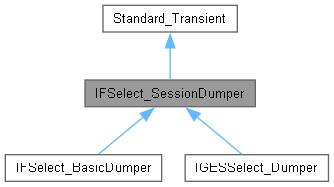
Implemented in IGESSelect_Dumper, and IFSelect_BasicDumper.
|
pure virtual |
Writes the Own Parameters of a given Item, if it forecast to manage its Type. Returns True if it has recognized the Type of the Item (in this case, it is assumed to have written the Own Parameters if there are some), False else : in that case, SessionFile will try another SessionDumper in the Library. WriteOwn can use these methods from SessionFile : SendVoid, SendItem, SendText, and if necessary, WorkSession.
Implemented in IGESSelect_Dumper, and IFSelect_BasicDumper.
 1.10.0