|
| | Storage_Schema () |
| | Builds a storage/retrieval algorithm based on a given data schema. Example For example, if ShapeSchema is the class inheriting from Storage_Schema and containing the description of your application data schema, you create a storage/retrieval algorithm as follows: occ::handle<ShapeSchema> s = new ShapeSchema;.
|
| |
| void | SetVersion (const TCollection_AsciiString &aVersion) |
| | returns version of the schema
|
| |
| TCollection_AsciiString | Version () const |
| | returns the version of the schema
|
| |
| void | SetName (const TCollection_AsciiString &aSchemaName) |
| | set the schema's name
|
| |
| TCollection_AsciiString | Name () const |
| | returns the schema's name
|
| |
| void | Write (const occ::handle< Storage_BaseDriver > &s, const occ::handle< Storage_Data > &aData) const |
| | Writes the data aggregated in aData into the container defined by the driver . The storage operation is performed according to the data schema with which this algorithm is working. Note: aData may aggregate several root objects to be stored together.
|
| |
| void | AddReadUnknownTypeCallBack (const TCollection_AsciiString &aTypeName, const occ::handle< Storage_CallBack > &aCallBack) |
| | add two functions to the callback list
|
| |
| void | RemoveReadUnknownTypeCallBack (const TCollection_AsciiString &aTypeName) |
| | remove a callback for a type
|
| |
| occ::handle< NCollection_HSequence< TCollection_AsciiString > > | InstalledCallBackList () const |
| | returns a list of type name with installed callback.
|
| |
| void | ClearCallBackList () |
| | clear all callback from schema instance.
|
| |
| void | UseDefaultCallBack () |
| | install a callback for all unknown type. the objects with unknown types will be skipped. (look SkipObject method in BaseDriver)
|
| |
| void | DontUseDefaultCallBack () |
| | tells schema to uninstall the default callback.
|
| |
| bool | IsUsingDefaultCallBack () const |
| | ask if the schema is using the default callback.
|
| |
| void | SetDefaultCallBack (const occ::handle< Storage_CallBack > &f) |
| | overload the default function for build. (use to set an error message or skip an object while reading an unknown type).
|
| |
| void | ResetDefaultCallBack () |
| | reset the default function defined by Storage package.
|
| |
| occ::handle< Storage_CallBack > | DefaultCallBack () const |
| | returns the read function used when the UseDefaultCallBack() is set.
|
| |
| void | WritePersistentObjectHeader (const occ::handle< Standard_Persistent > &sp, const occ::handle< Storage_BaseDriver > &theDriver) |
| |
| void | WritePersistentReference (const occ::handle< Standard_Persistent > &sp, const occ::handle< Storage_BaseDriver > &theDriver) |
| |
| bool | AddPersistent (const occ::handle< Standard_Persistent > &sp, const char *const tName) const |
| |
| bool | PersistentToAdd (const occ::handle< Standard_Persistent > &sp) const |
| |
 Public Member Functions inherited from Standard_Transient Public Member Functions inherited from Standard_Transient |
| | Standard_Transient () |
| | Empty constructor.
|
| |
| | Standard_Transient (const Standard_Transient &) |
| | Copy constructor – does nothing.
|
| |
| Standard_Transient & | operator= (const Standard_Transient &) |
| | Assignment operator, needed to avoid copying reference counter.
|
| |
| virtual | ~Standard_Transient ()=default |
| | Destructor must be virtual.
|
| |
| virtual const opencascade::handle< Standard_Type > & | DynamicType () const |
| | Returns a type descriptor about this object.
|
| |
| bool | IsInstance (const opencascade::handle< Standard_Type > &theType) const |
| | Returns a true value if this is an instance of Type.
|
| |
| bool | IsInstance (const char *const theTypeName) const |
| | Returns a true value if this is an instance of TypeName.
|
| |
| bool | IsKind (const opencascade::handle< Standard_Type > &theType) const |
| | Returns true if this is an instance of Type or an instance of any class that inherits from Type. Note that multiple inheritance is not supported by OCCT RTTI mechanism.
|
| |
| bool | IsKind (const char *const theTypeName) const |
| | Returns true if this is an instance of TypeName or an instance of any class that inherits from TypeName. Note that multiple inheritance is not supported by OCCT RTTI mechanism.
|
| |
| Standard_Transient * | This () const |
| | Returns non-const pointer to this object (like const_cast). For protection against creating handle to objects allocated in stack or call from constructor, it will raise exception Standard_ProgramError if reference counter is zero.
|
| |
| int | GetRefCount () const noexcept |
| | Get the reference counter of this object.
|
| |
| void | IncrementRefCounter () noexcept |
| | Increments the reference counter of this object. Uses relaxed memory ordering since incrementing only requires atomicity, not synchronization with other memory operations.
|
| |
| int | DecrementRefCounter () noexcept |
| | Decrements the reference counter of this object; returns the decremented value. Uses release ordering for the decrement to ensure all writes to the object are visible before the count reaches zero. An acquire fence is added only when the count reaches zero, ensuring proper synchronization before deletion. This is more efficient than using acq_rel for every decrement.
|
| |
| virtual void | Delete () const |
| | Memory deallocator for transient classes.
|
| |
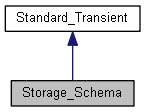
Root class for basic storage/retrieval algorithms. A Storage_Schema object processes:
- writing of a set of persistent data into a container (store mechanism),
- reading of a container to extract all the contained persistent data (retrieve mechanism). A Storage_Schema object is based on the data schema for the persistent data of the application, i.e.:
- the list of all persistent objects which may be known by the application,
- the organization of their data; a data schema knows how to browse each persistent object it contains. During the store or retrieve operation, only persistent objects known from the data schema can be processed; they are then stored or retrieved according to their description in the schema. A data schema is specific to the object classes to be read or written. Tools dedicated to the environment in use allow a description of the application persistent data structure. Storage_Schema algorithms are called basic because they do not support external references between containers.

 1.10.0