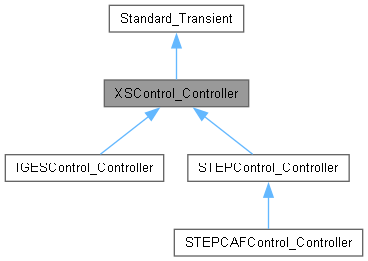
This class allows a general X-STEP engine to run generic functions on any interface norm, in the same way. It includes the transfer operations. I.e. it gathers the already available general modules, the engine has just to know it.
More...
|
| void | SetNames (const char *const theLongName, const char *const theShortName) |
| | Changes names if a name is empty, the formerly set one remains Remark : Does not call Record or AutoRecord.
|
| |
| void | AutoRecord () const |
| | Records <me> is a general dictionary under Short and Long Names (see method Name)
|
| |
| void | Record (const char *const name) const |
| | Records <me> in a general dictionary under a name Error if <name> already used for another one.
|
| |
| const char * | Name (const bool rsc=false) const |
| | Returns a name, as given when initializing : rsc = False (D) : True Name attached to the Norm (long name) rsc = True : Name of the resource set (i.e. short name)
|
| |
| const occ::handle< Interface_Protocol > & | Protocol () const |
| | Returns the Protocol attached to the Norm (from field)
|
| |
| const occ::handle< IFSelect_WorkLibrary > & | WorkLibrary () const |
| | Returns the SignType attached to the norm (from field)
|
| |
| virtual occ::handle< Interface_InterfaceModel > | NewModel () const =0 |
| | Creates a new empty Model ready to receive data of the Norm Used to write data from Imagine to an interface file.
|
| |
| virtual occ::handle< Transfer_ActorOfTransientProcess > | ActorRead (const occ::handle< Interface_InterfaceModel > &model) const |
| | Returns the Actor for Read attached to the pair (norm,appli) It can be adapted for data of the input Model, as required Can be read from field then adapted with Model as required.
|
| |
| virtual occ::handle< Transfer_ActorOfFinderProcess > | ActorWrite () const |
| | Returns the Actor for Write attached to the pair (norm,appli) Read from field. Can be redefined.
|
| |
| void | SetModeWrite (const int modemin, const int modemax, const bool shape=true) |
| | Sets minimum and maximum values for modetrans (write) Erases formerly recorded bounds and values Actually only for shape Then, for each value a little help can be attached.
|
| |
| void | SetModeWriteHelp (const int modetrans, const char *const help, const bool shape=true) |
| | Attaches a short line of help to a value of modetrans (write)
|
| |
| bool | ModeWriteBounds (int &modemin, int &modemax, const bool shape=true) const |
| | Returns recorded min and max values for modetrans (write) Actually only for shapes Returns True if bounds are set, False else (then, free value)
|
| |
| bool | IsModeWrite (const int modetrans, const bool shape=true) const |
| | Tells if a value of <modetrans> is a good value(within bounds) Actually only for shapes.
|
| |
| const char * | ModeWriteHelp (const int modetrans, const bool shape=true) const |
| | Returns the help line recorded for a value of modetrans empty if help not defined or not within bounds or if values are free.
|
| |
| virtual bool | RecognizeWriteTransient (const occ::handle< Standard_Transient > &obj, const int modetrans=0) const |
| | Tells if <obj> (an application object) is a valid candidate for a transfer to a Model. By default, asks the ActorWrite if known (through a TransientMapper). Can be redefined.
|
| |
| virtual IFSelect_ReturnStatus | TransferWriteTransient (const occ::handle< Standard_Transient > &obj, const occ::handle< Transfer_FinderProcess > &FP, const occ::handle< Interface_InterfaceModel > &model, const int modetrans=0, const Message_ProgressRange &theProgress=Message_ProgressRange()) const |
| | Takes one Transient Object and transfers it to an InterfaceModel (already created, e.g. by NewModel) (result is recorded in the model by AddWithRefs) FP records produced results and checks.
|
| |
| virtual bool | RecognizeWriteShape (const TopoDS_Shape &shape, const int modetrans=0) const |
| | Tells if a shape is valid for a transfer to a model Asks the ActorWrite (through a ShapeMapper)
|
| |
| virtual IFSelect_ReturnStatus | TransferWriteShape (const TopoDS_Shape &shape, const occ::handle< Transfer_FinderProcess > &FP, const occ::handle< Interface_InterfaceModel > &model, const int modetrans=0, const Message_ProgressRange &theProgress=Message_ProgressRange()) const |
| | Takes one Shape and transfers it to an InterfaceModel (already created, e.g. by NewModel) Default uses ActorWrite; can be redefined as necessary Returned value is a status, as follows : Done OK , Void : No Result , Fail : Fail (e.g. exception) Error : bad conditions , bad model or null model.
|
| |
| void | AddSessionItem (const occ::handle< Standard_Transient > &theItem, const char *const theName, const bool toApply=false) |
| | Records a Session Item, to be added for customisation of the Work Session. It must have a specific name. <setapplied> is used if is a GeneralModifier, to decide If set to true, will be applied to the hook list "send". Else, it is not applied to any hook list. Remark : this method is to be called at Create time, the recorded items will be used by Customise Warning : if <name> conflicts, the last recorded item is kept.
|
| |
| occ::handle< Standard_Transient > | SessionItem (const char *const theName) const |
| | Returns an item given its name to record in a Session If <name> is unknown, returns a Null Handle.
|
| |
| virtual void | Customise (occ::handle< XSControl_WorkSession > &WS) |
| | Customises a WorkSession, by adding to it the recorded items (by AddSessionItem)
|
| |
| const NCollection_DataMap< TCollection_AsciiString, occ::handle< Standard_Transient > > & | AdaptorSession () const |
| |
 Public Member Functions inherited from Standard_Transient Public Member Functions inherited from Standard_Transient |
| | Standard_Transient () |
| | Empty constructor.
|
| |
| | Standard_Transient (const Standard_Transient &) |
| | Copy constructor – does nothing.
|
| |
| Standard_Transient & | operator= (const Standard_Transient &) |
| | Assignment operator, needed to avoid copying reference counter.
|
| |
| virtual | ~Standard_Transient ()=default |
| | Destructor must be virtual.
|
| |
| virtual const opencascade::handle< Standard_Type > & | DynamicType () const |
| | Returns a type descriptor about this object.
|
| |
| bool | IsInstance (const opencascade::handle< Standard_Type > &theType) const |
| | Returns a true value if this is an instance of Type.
|
| |
| bool | IsInstance (const char *const theTypeName) const |
| | Returns a true value if this is an instance of TypeName.
|
| |
| bool | IsKind (const opencascade::handle< Standard_Type > &theType) const |
| | Returns true if this is an instance of Type or an instance of any class that inherits from Type. Note that multiple inheritance is not supported by OCCT RTTI mechanism.
|
| |
| bool | IsKind (const char *const theTypeName) const |
| | Returns true if this is an instance of TypeName or an instance of any class that inherits from TypeName. Note that multiple inheritance is not supported by OCCT RTTI mechanism.
|
| |
| Standard_Transient * | This () const |
| | Returns non-const pointer to this object (like const_cast). For protection against creating handle to objects allocated in stack or call from constructor, it will raise exception Standard_ProgramError if reference counter is zero.
|
| |
| int | GetRefCount () const noexcept |
| | Get the reference counter of this object.
|
| |
| void | IncrementRefCounter () noexcept |
| | Increments the reference counter of this object. Uses relaxed memory ordering since incrementing only requires atomicity, not synchronization with other memory operations.
|
| |
| int | DecrementRefCounter () noexcept |
| | Decrements the reference counter of this object; returns the decremented value. Uses release ordering for the decrement to ensure all writes to the object are visible before the count reaches zero. An acquire fence is added only when the count reaches zero, ensuring proper synchronization before deletion. This is more efficient than using acq_rel for every decrement.
|
| |
| virtual void | Delete () const |
| | Memory deallocator for transient classes.
|
| |
This class allows a general X-STEP engine to run generic functions on any interface norm, in the same way. It includes the transfer operations. I.e. it gathers the already available general modules, the engine has just to know it.
The important point is that a given X-STEP Controller is attached to a given couple made of an Interface Norm (such as IGES-5.1) and an application data model (CasCade Shapes for instance).
Finally, Controller can be gathered in a general dictionary then retrieved later by a general call (method Recorded)
It does not manage the produced data, but the Actors make the link between the norm and the application

 1.10.0