 |
Open CASCADE Technology Reference Manual 8.0.0
|
Loading...
Searching...
No Matches
|
Open CASCADE Technology Reference Manual 8.0.0
|
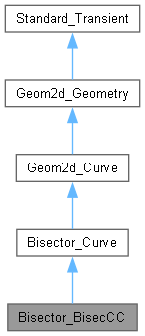
Construct the bisector between two curves. The curves can intersect only in their extremities. More...
#include <Bisector_BisecCC.hxx>
Public Member Functions | |
| Bisector_BisecCC () | |
| Bisector_BisecCC (const occ::handle< Geom2d_Curve > &Cu1, const occ::handle< Geom2d_Curve > &Cu2, const double Side1, const double Side2, const gp_Pnt2d &Origin, const double DistMax=500) | |
| Constructs the bisector between the curves <Cu1> and <Cu2>. | |
| void | Perform (const occ::handle< Geom2d_Curve > &Cu1, const occ::handle< Geom2d_Curve > &Cu2, const double Side1, const double Side2, const gp_Pnt2d &Origin, const double DistMax=500) |
| Computes the bisector between the curves <Cu1> and <Cu2>. | |
| bool | IsExtendAtStart () const override |
| bool | IsExtendAtEnd () const override |
| void | Reverse () override |
| Changes the direction of parametrization of <me>. The "FirstParameter" and the "LastParameter" are not changed but the orientation of the curve is modified. If the curve is bounded the StartPoint of the initial curve becomes the EndPoint of the reversed curve and the EndPoint of the initial curve becomes the StartPoint of the reversed curve. | |
| double | ReversedParameter (const double U) const override |
| Computes the parameter on the reversed curve for the point of parameter U on this curve. Note: The point of parameter U on this curve is identical to the point of parameter ReversedParameter(U) on the reversed curve. | |
| bool | IsCN (const int N) const override |
| Returns the order of continuity of the curve. Raised if N < 0. | |
| occ::handle< Bisector_BisecCC > | ChangeGuide () const |
| The parameter on <me> is linked to the parameter on the first curve. This method creates the same bisector where the curves are inversed. | |
| occ::handle< Geom2d_Geometry > | Copy () const override |
| void | Transform (const gp_Trsf2d &T) override |
| Transformation of a geometric object. This transformation can be a translation, a rotation, a symmetry, a scaling or a complex transformation obtained by combination of the previous elementaries transformations. | |
| double | FirstParameter () const override |
| Returns the value of the first parameter. Warnings : It can be RealFirst or RealLast from package Standard if the curve is infinite. | |
| double | LastParameter () const override |
| Value of the last parameter. Warnings : It can be RealFirst or RealLast from package Standard if the curve is infinite. | |
| GeomAbs_Shape | Continuity () const override |
| It is the global continuity of the curve : C0 : only geometric continuity, C1 : continuity of the first derivative all along the Curve, C2 : continuity of the second derivative all along the Curve, C3 : continuity of the third derivative all along the Curve, G1 : tangency continuity all along the Curve, G2 : curvature continuity all along the Curve, CN : the order of continuity is infinite. | |
| int | NbIntervals () const override |
| If necessary, breaks the curve in intervals of continuity <C1>. And returns the number of intervals. | |
| double | IntervalFirst (const int Index) const override |
| Returns the first parameter of the current interval. | |
| double | IntervalLast (const int Index) const override |
| Returns the last parameter of the current interval. | |
| GeomAbs_Shape | IntervalContinuity () const |
| bool | IsClosed () const override |
| Returns true if the curve is closed. Examples : Some curves such as circle are always closed, others such as line are never closed (by definition). Some Curves such as OffsetCurve can be closed or not. These curves are considered as closed if the distance between the first point and the last point of the curve is lower or equal to the Resolution from package gp which is a fixed criterion independent of the application. | |
| bool | IsPeriodic () const override |
| Returns true if the parameter of the curve is periodic. It is possible only if the curve is closed and if the following relation is satisfied : for each parametric value U the distance between the point P(u) and the point P (u + T) is lower or equal to Resolution from package gp, T is the period and must be a constant. There are three possibilities : . the curve is never periodic by definition (SegmentLine) . the curve is always periodic by definition (Circle) . the curve can be defined as periodic (BSpline). In this case a function SetPeriodic allows you to give the shape of the curve. The general rule for this case is : if a curve can be periodic or not the default periodicity set is non periodic and you have to turn (explicitly) the curve into a periodic curve if you want the curve to be periodic. | |
| gp_Pnt2d | ValueAndDist (const double U, double &U1, double &U2, double &Distance) const |
| Returns the point of parameter U. Computes the distance between the current point and the two curves I separate. Computes the parameters on each curve corresponding of the projection of the current point. | |
| gp_Pnt2d | ValueByInt (const double U, double &U1, double &U2, double &Distance) const |
| Returns the point of parameter U. Computes the distance between the current point and the two curves I separate. Computes the parameters on each curve corresponding of the projection of the current point. | |
| gp_Pnt2d | EvalD0 (const double U) const override |
| Computes the point of parameter U. Raises an exception on failure. | |
| Geom2d_Curve::ResD1 | EvalD1 (const double U) const override |
| Computes the point and first derivative at parameter U. Raises an exception if the curve continuity is not C1. | |
| Geom2d_Curve::ResD2 | EvalD2 (const double U) const override |
| Computes the point and first two derivatives at parameter U. Raises an exception if the curve continuity is not C2. | |
| Geom2d_Curve::ResD3 | EvalD3 (const double U) const override |
| Computes the point and first three derivatives at parameter U. Raises an exception if the curve continuity is not C3. | |
| gp_Vec2d | EvalDN (const double U, const int N) const override |
| Computes the Nth derivative at parameter U. Raises an exception if the curve continuity is not CN, or N < 1. | |
| bool | IsEmpty () const |
| double | LinkBisCurve (const double U) const |
| Returns the parameter on the curve1 of the projection of the point of parameter U on <me>. | |
| double | LinkCurveBis (const double U) const |
| Returns the reciproque of LinkBisCurve. | |
| double | Parameter (const gp_Pnt2d &P) const override |
| occ::handle< Geom2d_Curve > | Curve (const int IndCurve) const |
| const Bisector_PolyBis & | Polygon () const |
| void | Dump (const int Deep=0, const int Offset=0) const |
 Public Member Functions inherited from Geom2d_Curve Public Member Functions inherited from Geom2d_Curve | |
| virtual double | TransformedParameter (const double U, const gp_Trsf2d &T) const |
| Computes the parameter on the curve transformed by T for the point of parameter U on this curve. Note: this function generally returns U but it can be redefined (for example, on a line). | |
| virtual double | ParametricTransformation (const gp_Trsf2d &T) const |
| Returns the coefficient required to compute the parametric transformation of this curve when transformation T is applied. This coefficient is the ratio between the parameter of a point on this curve and the parameter of the transformed point on the new curve transformed by T. Note: this function generally returns 1. but it can be redefined (for example, on a line). | |
| occ::handle< Geom2d_Curve > | Reversed () const |
| Creates a reversed duplicate Changes the orientation of this curve. The first and last parameters are not changed, but the parametric direction of the curve is reversed. If the curve is bounded: | |
| virtual double | Period () const |
| Returns the period of this curve. raises if the curve is not periodic. | |
| void | D0 (const double U, gp_Pnt2d &P) const |
| Returns in P the point of parameter U. | |
| void | D1 (const double U, gp_Pnt2d &P, gp_Vec2d &V1) const |
| Returns the point P of parameter U and the first derivative V1. | |
| void | D2 (const double U, gp_Pnt2d &P, gp_Vec2d &V1, gp_Vec2d &V2) const |
| Returns the point P of parameter U, the first and second derivatives V1 and V2. | |
| void | D3 (const double U, gp_Pnt2d &P, gp_Vec2d &V1, gp_Vec2d &V2, gp_Vec2d &V3) const |
| Returns the point P of parameter U, the first, the second and the third derivative. | |
| gp_Vec2d | DN (const double U, const int N) const |
| Computes the Nth derivative vector. | |
| gp_Pnt2d | Value (const double U) const |
| Computes the point of parameter U on <me>. Implemented with D0. | |
| void | DumpJson (Standard_OStream &theOStream, int theDepth=-1) const override |
| Dumps the content of me into the stream. | |
| Public Member Functions inherited from Geom2d_Geometry | |
| void | Mirror (const gp_Pnt2d &P) |
| Performs the symmetrical transformation of a Geometry with respect to the point P which is the center of the symmetry and assigns the result to this geometric object. | |
| void | Mirror (const gp_Ax2d &A) |
| Performs the symmetrical transformation of a Geometry with respect to an axis placement which is the axis of the symmetry. | |
| void | Rotate (const gp_Pnt2d &P, const double Ang) |
| Rotates a Geometry. P is the center of the rotation. Ang is the angular value of the rotation in radians. | |
| void | Scale (const gp_Pnt2d &P, const double S) |
| Scales a Geometry. S is the scaling value. | |
| void | Translate (const gp_Vec2d &V) |
| Translates a Geometry. V is the vector of the translation. | |
| void | Translate (const gp_Pnt2d &P1, const gp_Pnt2d &P2) |
| Translates a Geometry from the point P1 to the point P2. | |
| occ::handle< Geom2d_Geometry > | Mirrored (const gp_Pnt2d &P) const |
| occ::handle< Geom2d_Geometry > | Mirrored (const gp_Ax2d &A) const |
| occ::handle< Geom2d_Geometry > | Rotated (const gp_Pnt2d &P, const double Ang) const |
| occ::handle< Geom2d_Geometry > | Scaled (const gp_Pnt2d &P, const double S) const |
| occ::handle< Geom2d_Geometry > | Transformed (const gp_Trsf2d &T) const |
| occ::handle< Geom2d_Geometry > | Translated (const gp_Vec2d &V) const |
| occ::handle< Geom2d_Geometry > | Translated (const gp_Pnt2d &P1, const gp_Pnt2d &P2) const |
| Public Member Functions inherited from Standard_Transient | |
| Standard_Transient () | |
| Empty constructor. | |
| Standard_Transient (const Standard_Transient &) | |
| Copy constructor – does nothing. | |
| Standard_Transient & | operator= (const Standard_Transient &) |
| Assignment operator, needed to avoid copying reference counter. | |
| virtual | ~Standard_Transient ()=default |
| Destructor must be virtual. | |
| virtual const opencascade::handle< Standard_Type > & | DynamicType () const |
| Returns a type descriptor about this object. | |
| bool | IsInstance (const opencascade::handle< Standard_Type > &theType) const |
| Returns a true value if this is an instance of Type. | |
| bool | IsInstance (const char *const theTypeName) const |
| Returns a true value if this is an instance of TypeName. | |
| bool | IsKind (const opencascade::handle< Standard_Type > &theType) const |
| Returns true if this is an instance of Type or an instance of any class that inherits from Type. Note that multiple inheritance is not supported by OCCT RTTI mechanism. | |
| bool | IsKind (const char *const theTypeName) const |
| Returns true if this is an instance of TypeName or an instance of any class that inherits from TypeName. Note that multiple inheritance is not supported by OCCT RTTI mechanism. | |
| Standard_Transient * | This () const |
| Returns non-const pointer to this object (like const_cast). For protection against creating handle to objects allocated in stack or call from constructor, it will raise exception Standard_ProgramError if reference counter is zero. | |
| int | GetRefCount () const noexcept |
| Get the reference counter of this object. | |
| void | IncrementRefCounter () noexcept |
| Increments the reference counter of this object. Uses relaxed memory ordering since incrementing only requires atomicity, not synchronization with other memory operations. | |
| int | DecrementRefCounter () noexcept |
| Decrements the reference counter of this object; returns the decremented value. Uses release ordering for the decrement to ensure all writes to the object are visible before the count reaches zero. An acquire fence is added only when the count reaches zero, ensuring proper synchronization before deletion. This is more efficient than using acq_rel for every decrement. | |
| virtual void | Delete () const |
| Memory deallocator for transient classes. | |
Additional Inherited Members | |
| Public Types inherited from Standard_Transient | |
| typedef void | base_type |
| Returns a type descriptor about this object. | |
| Static Public Member Functions inherited from Standard_Transient | |
| static constexpr const char * | get_type_name () |
| Returns a type descriptor about this object. | |
| static const opencascade::handle< Standard_Type > & | get_type_descriptor () |
| Returns type descriptor of Standard_Transient class. | |
Construct the bisector between two curves. The curves can intersect only in their extremities.
| Bisector_BisecCC::Bisector_BisecCC | ( | ) |
| Bisector_BisecCC::Bisector_BisecCC | ( | const occ::handle< Geom2d_Curve > & | Cu1, |
| const occ::handle< Geom2d_Curve > & | Cu2, | ||
| const double | Side1, | ||
| const double | Side2, | ||
| const gp_Pnt2d & | Origin, | ||
| const double | DistMax = 500 ) |
Constructs the bisector between the curves <Cu1> and <Cu2>.
<Side1> (resp <Side2>) = 1 if the bisector curve is on the left of <Cu1> (resp <Cu2>) else <Side1> (resp <Side2>) = -1.
the Bisector is trimmed by the Point <Origin>. <DistMax> is used to trim the bisector.The distance between the points of the bisector and <Cu> is smaller than <DistMax>.
| occ::handle< Bisector_BisecCC > Bisector_BisecCC::ChangeGuide | ( | ) | const |
The parameter on <me> is linked to the parameter on the first curve. This method creates the same bisector where the curves are inversed.
|
overridevirtual |
It is the global continuity of the curve : C0 : only geometric continuity, C1 : continuity of the first derivative all along the Curve, C2 : continuity of the second derivative all along the Curve, C3 : continuity of the third derivative all along the Curve, G1 : tangency continuity all along the Curve, G2 : curvature continuity all along the Curve, CN : the order of continuity is infinite.
Implements Geom2d_Curve.
|
overridevirtual |
Implements Geom2d_Geometry.
| occ::handle< Geom2d_Curve > Bisector_BisecCC::Curve | ( | const int | IndCurve | ) | const |
Computes the point of parameter U. Raises an exception on failure.
Implements Geom2d_Curve.
|
overridevirtual |
Computes the point and first derivative at parameter U. Raises an exception if the curve continuity is not C1.
Implements Geom2d_Curve.
|
overridevirtual |
Computes the point and first two derivatives at parameter U. Raises an exception if the curve continuity is not C2.
Implements Geom2d_Curve.
|
overridevirtual |
Computes the point and first three derivatives at parameter U. Raises an exception if the curve continuity is not C3.
Implements Geom2d_Curve.
Computes the Nth derivative at parameter U. Raises an exception if the curve continuity is not CN, or N < 1.
Implements Geom2d_Curve.
|
overridevirtual |
Returns the value of the first parameter. Warnings : It can be RealFirst or RealLast from package Standard if the curve is infinite.
Implements Geom2d_Curve.
| GeomAbs_Shape Bisector_BisecCC::IntervalContinuity | ( | ) | const |
Returns the first parameter of the current interval.
Implements Bisector_Curve.
Returns the last parameter of the current interval.
Implements Bisector_Curve.
|
overridevirtual |
Returns true if the curve is closed. Examples : Some curves such as circle are always closed, others such as line are never closed (by definition). Some Curves such as OffsetCurve can be closed or not. These curves are considered as closed if the distance between the first point and the last point of the curve is lower or equal to the Resolution from package gp which is a fixed criterion independent of the application.
Implements Geom2d_Curve.
Returns the order of continuity of the curve. Raised if N < 0.
Implements Geom2d_Curve.
| bool Bisector_BisecCC::IsEmpty | ( | ) | const |
|
overridevirtual |
Implements Bisector_Curve.
|
overridevirtual |
Implements Bisector_Curve.
|
overridevirtual |
Returns true if the parameter of the curve is periodic. It is possible only if the curve is closed and if the following relation is satisfied : for each parametric value U the distance between the point P(u) and the point P (u + T) is lower or equal to Resolution from package gp, T is the period and must be a constant. There are three possibilities : . the curve is never periodic by definition (SegmentLine) . the curve is always periodic by definition (Circle) . the curve can be defined as periodic (BSpline). In this case a function SetPeriodic allows you to give the shape of the curve. The general rule for this case is : if a curve can be periodic or not the default periodicity set is non periodic and you have to turn (explicitly) the curve into a periodic curve if you want the curve to be periodic.
Implements Geom2d_Curve.
|
overridevirtual |
Value of the last parameter. Warnings : It can be RealFirst or RealLast from package Standard if the curve is infinite.
Implements Geom2d_Curve.
Returns the parameter on the curve1 of the projection of the point of parameter U on <me>.
Returns the reciproque of LinkBisCurve.
|
overridevirtual |
If necessary, breaks the curve in intervals of continuity <C1>. And returns the number of intervals.
Implements Bisector_Curve.
Implements Bisector_Curve.
| void Bisector_BisecCC::Perform | ( | const occ::handle< Geom2d_Curve > & | Cu1, |
| const occ::handle< Geom2d_Curve > & | Cu2, | ||
| const double | Side1, | ||
| const double | Side2, | ||
| const gp_Pnt2d & | Origin, | ||
| const double | DistMax = 500 ) |
Computes the bisector between the curves <Cu1> and <Cu2>.
<Side1> (resp <Side2>) = 1 if the bisector curve is on the left of <Cu1> (resp <Cu2>) else <Side1> (resp <Side2>) = -1.
the Bisector is trimmed by the Point <Origin>.
<DistMax> is used to trim the bisector.The distance between the points of the bisector and <Cu> is smaller than <DistMax>.
| const Bisector_PolyBis & Bisector_BisecCC::Polygon | ( | ) | const |
|
overridevirtual |
Changes the direction of parametrization of <me>. The "FirstParameter" and the "LastParameter" are not changed but the orientation of the curve is modified. If the curve is bounded the StartPoint of the initial curve becomes the EndPoint of the reversed curve and the EndPoint of the initial curve becomes the StartPoint of the reversed curve.
Implements Geom2d_Curve.
Computes the parameter on the reversed curve for the point of parameter U on this curve. Note: The point of parameter U on this curve is identical to the point of parameter ReversedParameter(U) on the reversed curve.
Implements Geom2d_Curve.
Transformation of a geometric object. This transformation can be a translation, a rotation, a symmetry, a scaling or a complex transformation obtained by combination of the previous elementaries transformations.
Implements Geom2d_Geometry.
| gp_Pnt2d Bisector_BisecCC::ValueAndDist | ( | const double | U, |
| double & | U1, | ||
| double & | U2, | ||
| double & | Distance ) const |
Returns the point of parameter U. Computes the distance between the current point and the two curves I separate. Computes the parameters on each curve corresponding of the projection of the current point.
| gp_Pnt2d Bisector_BisecCC::ValueByInt | ( | const double | U, |
| double & | U1, | ||
| double & | U2, | ||
| double & | Distance ) const |
Returns the point of parameter U. Computes the distance between the current point and the two curves I separate. Computes the parameters on each curve corresponding of the projection of the current point.
 1.10.0